Category Archives: Doll Making

Hafren

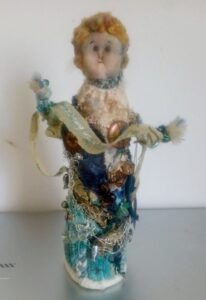
Doll-making is a form of story-telling.  It’s easier when you don’t have a choice of stories.

Hafren the Middle Child

There’s a legend about a Welsh king called Pumlumon who lived on a mountain in North Wales. One day he cast out his three daughters and told them to find their way to the ocean. Ystwyth, the youngest daughter loved to play and was always full of energy. She ran as fast as she could to the west and soon reached the coast. Gwy, the eldest, was the most beautiful of Pumlumon’s children. She wandered south through the rugged hills and wooded slopes of Wales and all who met her marvelled at her loveliness. Hafren was not like her sisters: she was slow moving and plain looking but of the three, she was the one who was blessed with a kind and generous nature. Hafren took a long time to wind her way to the sea, making sure that the folk who lived alongside her would find plentiful food in her waters and that their farm land would be rich and fertile.  The local people came to worship her as a water spirit.

Hafren the Innocent

There’s a legend about a Welsh king called Locrinus who was married to Gwendolen but had a child with his mistress, Sŵs-wên. They called their daughter Hafren.  After divorcing Gwendolen, Locrinus married Sŵs-wên and they lived with Hafren in a palace near the town of Caersws.  When Locrinus was fell in battle. Gwendolen raised an army, took Caersws and became Queen. She had Sŵs-wên killed then decreed that Hafren should be thrown into a nearby river and drowned. Many of her soldiers pleaded that Hafren should be spared because of her beauty and youth but Gwendolen, consumed by jealousy and hatred, saw to it her orders were carried out. From that day the river Hafren was named to honour the innocent princess. The Romans thought of Hafren as a river goddess and renamed her Sabrina, which over the centuries was anglicised to Severn.

Hafren the Escapologist

The Hall of Residence I lived in when I was at university in Cardiff was called Hafren. I had a room with a sofa bed, a sink, a wardrobe, a desk and a little one bar electric fire. The School of Home Economics – known affectionately as “Cooks” – was opposite the BBC studios in Llandaff and within easy walking distance of The Heathcock and The Malsters pubs. You went to The Heathcock if you wanted to spot TV stars and to The Malsters if you were more interested in standing at the bar alongside legends of the Welsh rugby team who were at their playing (and winning) best in the late 70s. Until “Cooks” got absorbed by the University of Wales it had delusions of being an Oxford college. We had scouts (the Oxford term for a maid) to make our beds, tidy our rooms and leave us a packet of biscuits once a week. The communal kitchen was spotlessly clean, dishes were washed and put away by invisible hands and there was always fresh milk in the fridge. If only I had wanted to live in Llandaff, study Textiles and become a teacher.  Sadly I hated the place, the subject and the career destination.  My bedsit in Hafren was where I sat every evening, eating biscuits and planning my escape into another future.  

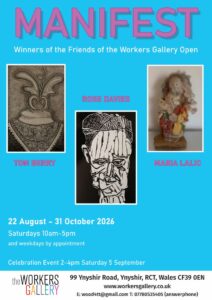
Have you guessed which story Hafren is telling?  She’ll be part of the Manifest exhibtion at the Workers Gallery this autumn if you want to take a closer look.


Oh Maisie

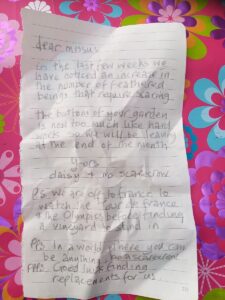
Years ago, when the legendary Terry Wogan manned the Radio 2 Breakfast Show, he invited  listeners to contribute endings to the phrase “You know it’s going to be a bad day when…”  One submission I recall was “you know it’s going to be a bad day when your child says Mum, did you know it was almost impossible to flush my teddy bear down the toilet.”  Now, I knew it was going to be a bad day when I got home a couple of weeks ago and found this note shoved through the letter box:

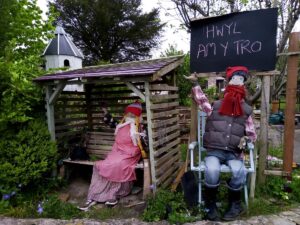
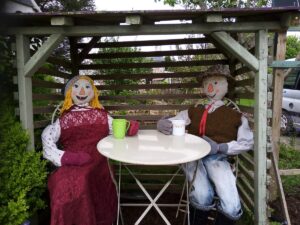
Daisy and Mo have been at the bottom of our garden for about 3 years and I don’t think them leaving has got anything to do with the increase in feathered beings we’ve had in the garden since Lily departed for the great cat basket in the sky.  I think it’s more to do with the fact that we’ve had a succession of wet and stormy winters.  They’ve been sat outside the whole time, developing mouldy rashes in all sorts of scarecrow nooks and crannies, so I can see why a warm and dry French vineyard might seem a better option.

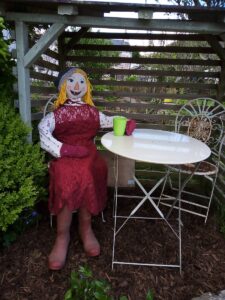
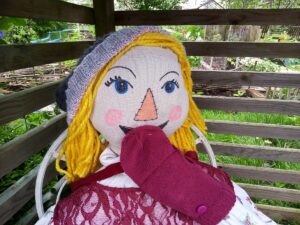
Anyway, true to the requirements of Scarecrow lore which decrees specific dates when scarecrows are allowed to wander, we got up on the morning of 1st of May to find the shed empty.  Advertisements to fill the vacancy had been posted in all the best fields and it wasn’t long before we’d appointed Maisie Corncockle.  Almost immediately her popularity was being indicated by beeping car horns from van drivers who were passing the garden and social media messages from adoring fans: “Wow – she’s a looker!” and “Will you bring her to Porthcawl so I can buy her hot chocolate with squirty cream?” being just two of the examples I had to stop Maisie replying to.

Were they disappointed I wonder to find that Maisie’s heart belonged to another?  Ptolemy Corncockle arrived last week and for a few days all seemed well.   The beans, peas and leeks are all planted and there has been no major crow activity so I was beginning to hope that the scarecrows might be effective and efficient members of staff.  Experience, however, tempers my optimism.

We have had scarecrows at the bottom of the garden for about 20 years and in that time they have proved themselves incapable of simply scaring crows.  They have appeared on television, been interviewed on the radio and featured in newspapers and magazines.  The first incumbents, Trevor and Lucille, were given notice to move on when they kept producing baby scarecrows and the shed simply couldn’t accommodate all the offspring.

Rowli and Cati Puw regularly received postcards from abroad, letters from local schoolchildren and anonymous presents including, once, a Christmas pudding in July.  Then Rowli was kidnapped one day by a man whose girlfriend had indicated she preferred Rowli to him.  Even though he was returned to the garden sitting in the back seat of a police patrol car (with his seat belt fastened), Rowli  never settled down again.  There have been other residents of the shed and none of them have been content to lead a quiet life and just do their job.  I have a feeling that there’s trouble brewing with Mr and Mrs Corncockle.   Only today I noticed that Ptolemy has turned his chair slightly so he can glare at the drivers who are being less than respectful to Maisie, like the chap this morning who went even slower than the 20mph limit and shouted “Hello Darling – dump him and come home with me!”

Oh, Maisie.

Sticky Betty

“What’s the matter with you?” demanded Annie this morning over breakfast.  “You’re all quiet.”

“I’m thinking.”

“About what?”

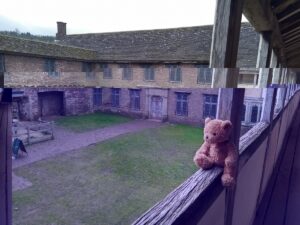
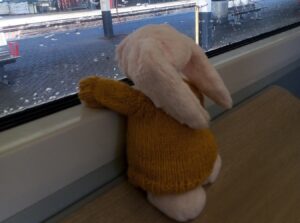
“This year’s Advent Calendar.  Last year I took photos of Smudge the unwanted toy rabbit in lots of different places I visited and posted one on Twitter every day in December; I did much the same with Aneurin the abandoned teddy bear in 2021.  I’m just wondering who should star in this year’s calendar.”

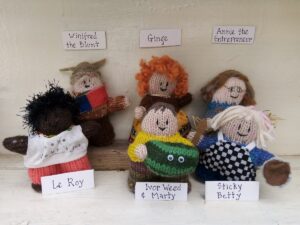
“What about them?” said Annie, waving a piece of buttery toast in the direction of the dresser where a collection of small knitted dolls stare blankly across the room.

“What, all of them?” I said.  “I can’t wander around Wales arranging that lot on castle walls.”

“Not all of them,” replied Annie.  “Just her on the end.  She’s famous already.  And no-one wants to see ruins.  They’re boring and in the middle of winter, they’re depressing too.    People want pictures of cafes and tearooms: cooked breakfasts of crispy bacon and fat sausages, glistening mushrooms, shiny red tomatoes, perhaps some baked beans but definitely no egg; or golden scones with little pots of strawberry jam or raspberry at a push but absolutely not blackcurrant; or those fabulous brie and cranberry melts with the lovely salad they do in The Potting Shed.  Like I said,”  Annie stood up and brushed her toast crumbs all over the floor, “if you’re going to do an advent calendar, you should realise that you’re the only person in the world interested in piles of stones.  The rest of us like food.”

Sticky Betty – A biography

The knitted inhabitants of Woollyton made their first appearance in May 2020 (In all our dreams ) when lockdowns were strict and humour was in short supply.  They starred in a sequel the following month which you can read here (The Mystery of the Missing Marshal)and then just before Christmas 2020 they emerged again from their world of knittiness to fundraise for the local foodbank.  After that I retired them and all would have been well except that Sticky Betty the eccentric and slightly wayward village cook saw an opportunity in the cost of living crisis to share her tightwad meal planning philosophy.  This year she has been pushing her way back into the limelight by occasionally sending recipes to the Baobab Bach Community Pantries website.

Owner of The Sticky Bun café and seller of anything which can be baked using free or at the very least, cheap ingredients, Betty is on a mission to put global brands of convenience food out of business.  And whilst she’s on her soap box, she would like everyone to know that if you are going to treat yourself to eating out occasionally, most small local cafes and bakeries cook proper food made from proper ingredients served on proper plates instead of splodged unidentifiable meat bits from the other side of the world that are wrapped in paper or sealed in plastic before being slapped on the counter for you to take away.   If you fancy trying some of Sticky Betty’s recipes, here are 3 for you to download and/or print.

Sticky Betty’s Cheese and potato pie

Sticky Betty’s Fluffy Blueberry Pancakes

Sticky Betty’s Spicy Stir Fry August 2023

Meanwhile if you’re out and about in South Wales between now and December and spot a woman who should know better positioning a small knitted doll in front of a big cream cake and a mug of cappuccino, that’ll be me.  Sticky Betty’s Advent Calendar will only be available on my social media unless some publishing company knocks on my door and offers me a large amount of money for the rights, most of which I will probably have spend on signing up to a weight loss programme in January.

Barefoot in Crickhowell

Pitchfork and Kinder Scout

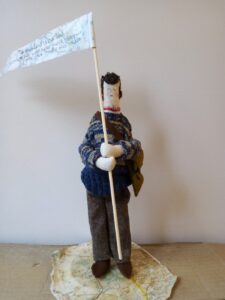
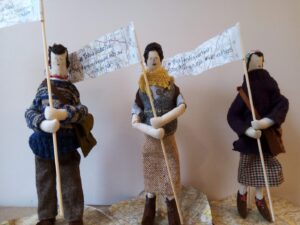
For the next couple of months I’ve got three dolls on display as part of the “Pitchfork” exhibition at The Workers Gallery in Ynyshir.   The exhibition is exploring the use of domestic objects as artefacts of resistance and defiance.  I confess that it took me a while to decide what my defiant dolls were going to protest about because there are so many possibilities in the UK at the moment, including it not being legal to protest.  In the end I settled on Kinder Scout, a name that most people in the walking/rambling/hiking world are familiar with.  Kinder Scout is a tor in the Derbyshire Peak District and on the 24th April 1932, it was the scene of a mass trespass across moorland that was owned by the very rich Duke of Devonshire.  He used it to shoot grouse for 12 days a year and fenced it off the rest of the time.  More than 400 workers from the factories and industrial heartlands of Manchester and Sheffield converged at the start of the walk and were met by estate workers of the Duke of Devonshire and a large contingent of the Derbyshire Constabulary.  Inevitably scuffles broke out and when the (alleged) five ringleaders were arrested and subsequently sentenced to prison, the whole episode should have been recorded as a win for the aristocracy.  But it wasn’t.   In the years since 1932 the Kinder Scout Mass Trespass has become a talisman of the unfairness of land ownership, inequality of wealth distribution and the class divide.  Every 24th April, up and down the country, walking groups and individuals recreate the Kinder Scout Mass Trespass not only as a symbolic gesture of resistance and defiance but also as a rallying cry for the expansion of access rights and protection of the environment.

Cat sitting and Defiance – a risky combination


Although I’m as Welsh as anyone born and brought up in Port Talbot can be, my family tree has roots and branches right across Europe.   The only thing which links my ancestors is that they all come from working class or peasant stock.  We have always been poor, honest, salt of the Earth kind of people.   I think it’s thanks to the varying traumatic experiences of my antecedents at the hands of the rich and/or powerful that I have a profound distaste for injustices however they manifest themselves.  In particular I get really, really annoyed at a social system that relies on – and is perpetuated by – the “haves” being entitled to more rights than the “have nots”.  One of the things I liked about the history of the Kinder Scout Mass Trespass is that although the people arrested were men, many of those who took part in the protest were women.  As one branch of my family tree lived in Manchester and may have wanted to walk on Kinder Scout, I decided to make dolls called Annie, Edith and Mabel and to stand them on maps of the Derbyshire Peak District. This is where it got a bit tricky because I had to finish the dolls whilst I was doing cat-sitting job at a very posh house in a very posh part of Wales.

Measuring Poshness

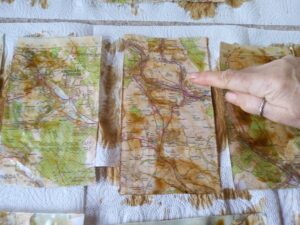
How posh is posh? Well, Crickhowell has only three charity shops (my home town has about 12) but at least one of them yielded an old OS map of Derbyshire.  Mind you, I still needed to laminate the paper.  Without my laminator – indeed, without many of the bits and bobs that a mixed media artist keeps in their studio – it came down to an afternoon of paper tearing, some fragrant and probably expensive coffee (found in the pantry), a pot of PVA glue (found in the garden shed) and a desperate hope that the very expensive kitchen worktops in the posh house would recover.


Annie

I had taken some prepared dolls to Crickhowell with me but as there is no mention in any press reports of the day about the Kinder Scout protestors being naked, clothes needed to be made.  I had a small sewing kit and a couple of scraps of fabric and felt.  That sorted out the boots and the skirts but unless the dolls were going to be topless as they launched their campaigns, they were going to need jumpers.  I intended Annie to be waving a flag raising awareness about the need to care for nature in general and pollinators in particular.  She thinks someone needs to make politicians understand that when the last bee has died, it won’t matter how much money you’ve got because there’ll be no artisan bread left to buy when there’s been no wheat harvest.  Is that a message that people will listen to if Annie is flouncing around, not wearing a sweater?  I don’t think so but I had no suitable material.

Hmmmm.  Think hard and look at the dark red socks I’m wearing.

Edith

Edith is demanding better public transport and traffic free routes – both causes close to my heart.  I love bus travel and am ancient enough to remember when there were conductors on the old Western Welsh buses.  The back seats were reserved for the chain smokers, those who liked the occasional cigarette clustered in the middle part of the bus and the non-smokers were in the front couple of rows.  In 1970s Bridgend, the service known as the “Flyer” – it missed out the loop around a local council estate and meant you could get from our village to town in 10 minutes instead of 25 – would speed into the bus station, swerve into a massive washing shed with giant water hoses, thick rotating brushes and industrial sized bubbles, and the driver shouting “CLOSE THE WINDOWS, KIDS!”  Who needed to go to a fun fair?  It was the highlight of our Saturday mornings.  We (as a country) should never have de-regulated public transport and Edith agreed with me, or she would have if she wasn’t topless as well.

Think harder and look at the blue Fair Isle socks ready to be worn tomorrow.

Mabel

I grew up in Port Talbot where the beach was sandwiched between the steelworks on one side and the BP petrochemical plant on the other so I know what it’s like to swim in polluted water.  But there’s a difference between splashing about in heavy chemicals and wallowing in raw sewage.  The solution is, of course, very simple.  The people who make the decision that it’s ok to put untreated excrement into our rivers and seas should be first in the water to prove its health giving properties to the rest of us.  I did think of putting Mabel in a bathing costume made of a pair of knickers to make her point but luckily I found some emergency fabric for a skirt.  That still left the lack of a top.  The night time temperatures in Crickhowell in late February are generally known as nobbling.  Especially in a house where Alexa only condescends to put the central heating when it suits her rather than my feet. 

Not surprisingly I looked hardest of all at the last pair of socks in my suitcase.

Last Thoughts

So there we are – if you live in South Wales and want to see my resistant and defiant efforts, the Pitchfork exhibition is on Fridays and Saturdays until the 8th July.  You will be able to find out about one of the seminal protest events of the 20th century, appreciate my doll making skills and – if that’s not enough excitement – you can get up close and personal with my socks.

Resistance is not futile

Hands up those of you who have managed (like me) to get to a ripe old age living with PDA without realising it is an actual condition rather than a natural tendency to be arsey.  PDA stands for Persistent Drive for Autonomy and in its extreme state it can cause crippling anxiety and lots of negative socialisation challenges.  I am not extreme so for me, PDA manifests itself as a resistance to being told what to do by pretty much anyone who hasn’t asked my permission first to tell me what to do.  You might see how this attitude could impact on my ability to win friends and influence people in a workplace like the NHS or in the various universities that I have graced with my presence over the years.  Actually I was best friends with PDA from the minute Tracy Jones (the school bully at Ynysawdre Comprehensive and nemesis of the 13 year old me) told me her favourite pop group was Slade and I had to – Hang on! I’m getting behind of myself.  Let’s go forward a bit…


After Protest Comes Resistance

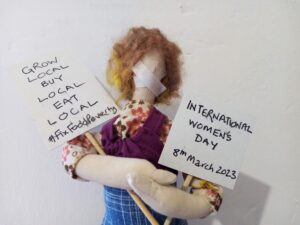
2022 was remarkable in that I took part in two excellent exhibitions with The Protest Dolls.  Some of them have just had another little outing to mark this year’s International Women’s Day but all of them are responsible for me being invited to submit 3 dolls to another exhibition at The Workers Gallery, the theme of which centres on objects of resistance and defiance rather than protest.  As is so often the case when an exhibition is mooted, I haven’t a clue where to start but luckily I am surrounded by people who respond when I send out a broadcast Watsapp text asking for their input.  On this occasion I explained the subject and that I would appreciate their replies.  It turns out that I know some seriously angry folk.   I mean, incandescent with rage level of angry.  Mostly about the intentional and possibly imminent destruction of the NHS by the present government but then there were also forays into inequality, injustice, misogyny, a deliberate policy to increase poverty and social division as well as the ill-treatment of people with disabilities before we scraped the bottom of the reality barrel with “and that awful television programme Dancing on Ice”.  Apart from the slip sliding celebrities, there seemed to be a central clustering around a disagreement with the sense of entitlement some individuals and industries feel, getting rich and abusing power at the expense of both public services and the people they purport to serve.  I gathered together all my research materials and waited for an idea to surface.

False Start

What about making an NHS doll that looked ancient and worn out by the effort of keeping going in the face of underfunding, gaslighting and the threat of privatisation?  I printed Nye Bevan’s immortal words on some cotton and then aged it in some coffee dye.


And then I thought this isn’t an object of resistance: it’s a statement of protest.  Which is why I went back to the drawing board and recalled the nightmare which was Tracy Jones.

It’s Noddy Holder Or Else

In Lainey Lancaster’s book “Nana Joy and The Sadness of the World”, objects take on meaning and meaningfulness.  I don’t clutter my life with sentimental stuff but there are some things I remember having because they were important symbols of a decision I took.  My school satchel was just such a thing.  In the days before rucksacks we all packed our books and sandwiches into leather satchels.  My sisters both had ugly dark brown things but mine was a beautiful tan colour.  And whereas theirs got both scuffed and scruffy, I used to polish mine with Cherry Blossom Tan shoe polish so that even two years into Comprehensive School, my satchel was still smart and shiny.   Sadly, this annoyed Tracy Jones.  One Friday afternoon she pushed me up against the cloakroom wall and demanded that I should carve the name of the lead singer of her favourite pop group on the front of my satchel.  Fair play, she even held up a blunt Swiss Army knife that I could borrow to do the deed but then as the end of school bell rang, she generously allowed me a reprieve.  By Monday, she said, my satchel would have to have to say Noddy Holder or else.

School photograph


It took me all weekend to work out a plan and then an hour scratching into the leather of my satchel with the point of a geometry compass on Sunday night but by Monday, thanks to my PDA, I was ready for Tracy.  She and her lieutenants cornered a group of us after lunch.  One by one, satchels were inspected for Noddy Holder’s name, and then she came to me.

“Who the f*ck is Colin Blunstone?” she demanded.

“Haven’t you heard of him?” I said incredulously.  “He’s higher in the charts than Slade at the moment.  He was on the Top 20 yesterday and Top of the Pops last week.”

“Course I’ve f*cking heard of him. (She clearly hadn’t.) He sings that song. ..”  Her lieutenants started to titter.

“I don’t believe in miracles,” I offered helpfully as she shoved me into the wall and stomped away.

Although I have ever since because thereafter Tracy Jones left me – and my satchel – alone.

An Object of Resistance

So I realised that in the same way as the Protest Dolls simply held their placards aloft, I could make a doll which was a carrier of an object of defiance to something or someone.  If you think about it, all forms of resistance come about because an individual has a drive of autonomy.  When we fall into the habit of acquiescence, we internalise anger rather become defiant.  The whole point of autonomy is that it allows you to develop strategies to do something about the situation you find yourself in.  Each of the dolls I’m making for this exhibition will hold and stand on some crafted symbol of resistance.  The event they represent proved to be anything but futile and it is one which still resonates with me partly because it relates to a personal interest and partly because if there’s one thing (actually there are a lot of things) I can’t stand in this world, it’s bullying.  The way in which some people think that they can impose their will on anyone else just because they want to is just wrong, plain and simple.  It’s the resistance to that wrongness that my Defiant Dolls are going to commemorate.  And look, one of them will be carrying a teeny weeny replica of my satchel as a gesture.  The map might give you a clue as to what the final subject will be but if you can’t guess, I’ll explain more in next month’s blog.

Incidentally

I still carry a satchel of sorts although these days they’re called Field Bags.  Mine now is made from a hi-tech waterproof fabric but it’s got enough space for my books and sandwiches as well as a pocket designed specifically, it seems from size and shape, for a bag of giant chocolate buttons.  I took it with me this week when I went to visit a nature reserve near Talgarth called Pwll y Wrach – The Witches’ Pool but there was no sign of Tracy Jones so my satchel still doesn’t say Noddy Holder.


New Year, Nearly New Plan

It’s that time of year when I give the website a good spring clean.  Truth be told, I actually started in November last year when I changed the domain name from marialalic.co.uk to marialalic.cymru.  Well, I say I changed it but I’m sure we all know that it wasn’t me because I am IT skills deficient.  What I did was send an email to Stuart at Tekeez (my website hosts) and said “Can I do this?” and “How much will it cost me?” to which he replied “Yes, you can” and “£20”. Bargain.  Especially if I start keeping the website up to date and paying attention to things like page views and bounce rates.  This is unlikely, however.  Over the years I’ve been told by lots of people who have been very sure that they know what’s best for me and my business model that the only reason to have a website is to attract paying customers to things or skills I have to sell.


Actually the only reason I have a website is so that I can keep track of what I’ve done and what I want to do.  This sort of filing system is important because half of my brain likes to think of itself as a serious, meaningful artist and the other half only wants to make the sort of homespun craft that Caroline Ingalls would have kept in her Little House on the Prairie.  Quite often the two halves end up jostling for supremacy and the winner takes all of my time, effort and money for a few weeks or months.   Until recently the website was a bit like the miscellaneous drawer that everyone has at home: a place where things are lost when they are needed and found when they are not.  But not anymore.  Behind the scenes, there is a digital tidy up in progress.  I have updated the Gallery and the Timeline and I have rewritten the page on Doll-Making.

Perhaps next month I will explain a bit more about this year’s serious, meaningful art project but for the moment, Caroline Ingalls is in the ascendant so let me introduce you to Scarecrow Cottage.   When I first became self-employed, selling at craft markets made up a lot of my earnings.  I didn’t have a car so everything would be rammed into a suitcase on wheels and I’d trundle from house to bus stop then bus stop to wherever the event was.  On a good day I’d bring home fewer goods and more money than I started out with but there were occasions when I was just happy to earn enough to be able to pay for the table.  I stopped doing craft markets for a few years while I was concentrating on my MA, the Unlost Places project and a growing mentoring practice but lately, I’ve been thinking I want to get back out there.  And let’s face it – could there be a better time to get people to interact with teddy bears than during a cost of living crisis, a period of social unrest and at the beginning of an economic recession?  All of which brings us to the three different facets of Scarecrow Cottage (none of them require you to visit an online shop).

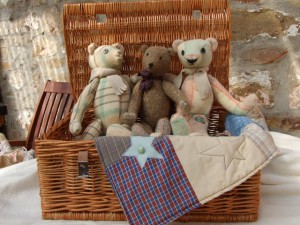
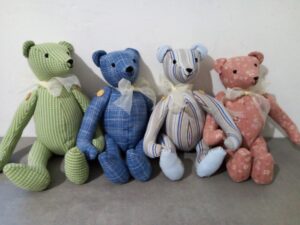
Hand made teddies

Scarecrow Cottage Hospital

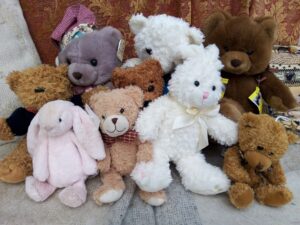
What first started as repairing a very distressed Raggedy Andy for a friend has now become a bit of a phenomenon on my social media platform.  Take Smudge, for example.  Smudge (the little pink rabbit, front left) was part of a large group of soft toys that were to be gifted to a local charity so that they could distribute them as Christmas presents.

Sadly Smudge had a stain that wasn’t removed in spite of repeated laundering.  Smudge developed a cult following thanks to posts on social media.  He starred in his own online Advent calendar; people offered to knit him jumpers; strangers wanted to adopt him; at the New Year’s Eve parkrun in Porthcawl a bloke sidled up to me and said “How’s Smudge?”  as if he really cared about the answer.   The point of this ramble is that most people would prefer to see soft toys repaired and re-homed than sent to make yet another layer of landfill.

So my plan is to take Scarecrow Cottage Hospital on tour to libraries, museums, vintage fairs, craft markets or anywhere else where people can watch as a distressed or injured teddy bear, cloth doll or little pink rabbit is given a second chance of life.  Programmes like The Repair Shop and Money For Nothing have shown that there is an appetite for mending instead of throwing away and it’s not just because it makes more economic sense.

Scarecrow Cottage Crafts

In my dreams I’m going to have a log cabin in the bottom of my garden and I’m going to fill it with vintage lace, embroidered tablecloths, patchwork quilts, teddy bears, cloth dolls and cat-related ephemera.   And a doll’s house.  And the bits and bobs to go in a doll’s house.  Until that day comes I’m going to amuse the craft side of my brain by sourcing and making these things.  And if I turn up at a craft market and put all of my treasures on the table, it won’t bother me at all if people want to look and admire rather than spend money (though if that’s what they want to do I won’t stop them).  The lesson that I’ve learnt from my early days of selling stuff is that I shouldn’t try to get inside the heads of potential customers.  I need to make the things that will look at home in my log cabin.  If I meet kindred spirits (aesthetically speaking), that would be lovely but equally, if I end up bringing everything home, my log cabin is better furnished.  Definitely a win-win situation.

 Scarecrow Cottage Memories

For as long as I’ve been self-employed I’ve refused to do commission work.  This has mostly been because I’ve never felt confident about being able to translate a customer’s imagination into a piece of artwork.  It had never occurred to me to take craft commissions but last autumn I gave in to a request and made some memory bears from my own pattern.  Then I made a memory doll – again from my own pattern.  So while the textile artist me is still going to refuse to take commissions, I think Scarecrow Cottage Memories – the teddy bears and dolls made from fabrics that have personal history to a someone I perhaps don’t know yet – is a great way to use heritage craft skills and keep stories alive.

There’s been some discussion recently about whether people are losing the ability to absorb more than a few lines of writing.  If you’re down here and you’ve read the blog as well as looked at the pictures, you’re bucking the trend of humanity so congratulations on being someone special – the world needs you!

Ripples and Fairies

I don’t want to minimise the grim reality faced by so many people in today’s world but there’s something that we can all do to contradict the belief systems of billionaires, corrupt politicians and megalomaniacs and that thing is to spread a ripple of kindness, humour and goodwill.   Hopefully some of these better traits of humanity will rub off on them because as Robert F Kennedy said:

Each time a man stands up for an ideal, or acts to improve the lot of others, or strikes out against injustice, he sends forth a tiny ripple of hope, and crossing each other from a million different centers(sic) of energy and daring those ripples build a current which can sweep down the mightiest walls of oppression and resistance.

The History of Fat Fairies – for the more MATURE Christmas tree

December 2007.  It’s my first ever craft show and my first ever outing with the over-stuffed cloth dolls that I am hoping to sell.  The show isn’t a success but the fat fairies are.  Indeed they prove so popular that I’ll be making at least 20 for Christmas events every year until 2022 and I’ll usually start each January with none left.

There’s no denying that some craft shows can be dire experiences for sellers.  The one in December 2007 was held backstage in a council owned theatre.  Dirty ripped black curtains draped down dusty walls and the organiser had issued an edict that Christmas decorations were not to be pinned to them in order to avoid damage – whether she meant damage to the curtains or to the decorations wasn’t clear.  Outside rain poured incessantly for the entire week of the market.  Inside the several holes in the roof made sure we all knew about the weather as water splattered on the bare floorboards.   Add to this that no-one had seen fit to advertise the event in the local press or the village or even put posters on the front door of the theatre building with arrows to direct people from the box office through the library, down the corridor, turn left at the toilets, past the café and into the auditorium before ascending some wooden steps and pulling back the safety curtains.  However a few of my fat fairies sold to other stallholders and there was enough positive feedback to ensure they’ve graced the world stage ever since.

Fat Fairies are for everyone

November 2011.  I have a stand at the Royal Welsh Winter Fair and one whole wall is covered by fat fairies.  The show chaplain -–a chubby and very jolly Anglican priest – arrives with an unusual request.  Would I, he wondered, take his photograph standing next to the big poster which said in large red letters “Fat Fairy – for the more MATURE Christmas tree”?  And furthermore, would I agree to him having the photograph printed on cards he could send to his congregation.  I say yes, of course.  A few hours later and I notice a man inspecting all of the fat fairies with forensic precision.  Eventually he settles on a buxom wench with bright yellow hair and a red velvet dress.  As he pays he tells me it’s a present for the woman he wants to marry but before he asks the question, he needs to know what sort of sense of humour she’s got.  If she takes the doll as a personal affront, she’s not the one for him; if she laughs, she is.


In all of the years I’ve been selling the fat fairies, this was the only time they have attracted the attention of men.  Women get the joke on the strap line and often buy the dolls either to celebrate their own size or to send to friends who will appreciate the sentiment.

But not for much longer

Since 2007 about 300 of them have found their way across the globe but guess what?  Their time is coming to an end.  I might make more but for the first time in 15 years, I’m thinking I might not.  As I’m not doing any craft fairs this Christmas, I have put this year’s tranche of fat fairies on my Etsy shop here .  I have to confess I am surprised that no-one has replicated the pattern or the motto.  In case you want to, here’s the pattern .

If you can sew, you don’t need instructions.  If you can’t sew, you’ll need to learn before you can make one.  Meanwhile I’ll be finding other ways to make ripples.


Blame it on the Clangers

Proverbs are great for providing brief responses when you have to explain yourself or try to avoid the blame game at short notice.  I’ve always thought that pride comes before a fall and calm comes before a storm have a pragmatic, I-told-you-so sort of wisdom to them. Now I’ve added another one to the collection: knitting Clangers comes before index finger tendonitis.

Pride

My default setting is to be contrary so when there was a surge of enthusiasm for decorating street furniture with regal yarnbombing to mark the Platinum Jubilee, I knew that I wasn’t going to just resist the trend – I was going to buck it.  If I were the sort of person to tie knitted things in public places which – as it’s technically illegal (littering) – obviously, I would never do, then I would need to make something distinctly un-royal to attach to some hypothetical traffic bollards on a hypothetical main road near my hypothetical home.  And so it came to pass that I obtained a book of Clanger knitting patterns and my worst nightmare was about to unfold.

To be fair I couldn’t just blame it on the Clangers: they didn’t cause the tendon in my right index finger to start screeching with pain every time it adopted the knitting position.  No, it was the double whammy of knitting Clanger bodies on consecutive days then crocheting Clanger planets (one for each hypothetical bollard) in the evenings that really did the damage.


Fall

At the start of May, with my best and most important finger swollen and inflamed, I realised that any hope of a Clanger takeover of concrete posts was doomed.  One afternoon I consulted Dr Google, applied the advised ice, rubbed in the advertised anti-inflammatory gel and rested as instructed.  The morning after I was disappointed to find that none of these had cured my digital ills and as I had three dolls to make in as many days for the exhibition of Heritage Crafts at The Turner Gallery in Penarth, my finger was told to take one (or three) for the team.  The five Clanger planets, one completed Clanger and a pile of pink woolly body parts were consigned to the UFO basket in my workroom – a harsh but necessary decision.

Calm

Mid May and all of the Protest Dolls were safely installed in Penarth for a month so it was time for me to turn my attention to my Unlost Places project.  Unlost Places involves me visiting places in Wales which are atmospheric, mysterious and other-worldly, then making arty stuff to illustrate what it’s like to be there.   As there isn’t a map upon which places are marked as “atmospheric”, “mysterious” or “other-worldly”, I think it would be a good idea to write a book about them (with photographs of my arty stuff for anyone who doesn’t want to read the boring bits).


Caldy Island

People who love Tenby say that everyone should go to Caldy Island.  I don’t particularly love Tenby because I’m traumatised by the cheap hotel room I stayed in once.  It turned out to be cheap because it was also the main fire escape for guests staying on the same floor, all of whom evacuated the building when there was a (false) alarm at 2 o’clock in the morning by forcing open my bedroom door.  They traipsed past a stunned and terrified wide-eyed me who was clutching trembling blankets to my chin – like that was any sort of defence against what I presumed at the time was a zombie invasion.  Anyway, my point is that as I don’t love Tenby, I should have heeded my instinct about Caldy, which was to not bother paying the £13 for a ferry ride and to have a nice ice cream and wander around town instead.  But as I said earlier, I am nothing if not contrary so I went.  It takes about 30 minutes to sail to the island and then weirdly, it’s like you’ve arrived on a film set that’s a cross between The Stepford Wives and The Prisoner.  There’s not a single blade of grass out of place on the manicured lawns and it’s chocolate box pretty,  with quaint little houses overlooked by an Italianesque abbey perched high on a wooded hillside.

I wasn’t looking for pretty, quaint or Italianesque so whilst everyone else who had been on the boat stayed in the village, I headed along a trail through the trees which was a bit more atmospheric but not deeply so.  Still I managed to create some Unlost Places indigenous art and took a moody photograph before getting on the first ferry back to Tenby.  Unsurprisingly Caldy Island is not going to make it into my book of creative maps.

Amroth

I’ll tell you what I like about Amroth.  It’s a dead end.  The road skirts along the beach making a lovely flat promenade for walking and then it stops, not even attempting to turn itself into a little lane that could lead over the headland to the hamlet of Marros.  There’s archaelogical evidence that people have been calling Amroth home for thousands of years.  Some locals say that the name Amroth comes from a little stream that bubbles into the sea here; others that it relates to a “rath” (Iron Age earthwork) high on the ridge.  Amroth Castle is now privately owned and a rebuilt, re-imagined version of its 12th Century origins.  St Elidyr’s Church, a mile up a vertiginous track that runs from the seashore to the isolated hilltop farms, is also medieval and probably built on the site of an early Christian llan.  And just as you’re thinking that all Amroth has to offer is a few cafes and shops, a bit of manageable Welsh history and a comforting air of nothing-to-do-ness, it turns out that there’s a sizeable chunk of industrial heritage too because of the anthracite mining that used to go on in the area.  The exciting thing however from my point of view is that Amroth was/is also on a pilgrim route.

Follow the Wales Coast Path east and you pass through Marros to Pendine then on to Laugharne and Llansteffan.  Take the ferry across the estuary to Glan y Ferri and before long you pass St Ishmael’s and join the pilgrim road to Kidwelly.  Or if you climb the steps at the western end of the beach, the path leads you to Wiseman’s Bridge where there’s a woodland trail towards Kilgetty, Templeton and all spiritual points leading to St David’s.   Apparently the effort of two pilgrimages to St David’s is equivalent to one to Rome but if for you, step climbing is beyond the pale – fear not!   Amroth has an alternative.  At low tide the sea retreats far enough for all but the least intrepid person to walk across the sands to Wiseman’s Bridge and even carry on to Saundersfoot, a mile away.  When the tide comes back in, there’s a traffic free path along a disused railway line which gives a safer journey.  It skirts the coast and plunges in and out of dimly lit tunnels either side of the lovely Coppet Hall beach.

When I write Amroth up to go in the book, I’ll do more research; I’ll put in more facts; I’ll take photographs of my arty stuff as illustrations.  Which brings us back to my Clanger caused index finger tendonitis.  How does a textile artist make textile art and a doll maker make dolls when she can’t stitch?  Well, it turns out to be not that difficult if you have access to bondaweb

or if you learnt your doll making in the 1970s.  I do confess to sewing the eyes onto the Amroth Pilgrim Doll but otherwise no needles were threaded in the cause of this blog post.

Storm

The invalid finger has another five weeks of sick leave to go before it is unleashed, hopefully recovered, on an unsuspecting world.  Given that there are five planets crocheted but only three Clangers knitted, you might think that I have a decision to make.  You might think that I should risk knitting another two Clangers.  Or you might consider that I should buy some green felt and sew a Soup Dragon and some silver fabric to make an Iron Chicken.   Well, it turns out that none of these apply because last week during one of those rainstorms which we get all too often these days, a woman who was texting instead of concentrating on driving swerved her new car across the road, aquaplaned and collided with the bollards.  Luckily no-one else was involved and she wasn’t hurt.  Inevitably though, the police were summoned and required an explanation of what caused such concrete carnage .  Now imagine if I had managed to finish and position my pink knitted aliens and blue crocheted planets.  Like some people, the texting woman wouldn’t have taken responsibility for her own actions – she would have blamed it on the Clangers.

Fancy being so self-delusional.

The Protest Dolls

This all started when the Heritage Crafts Association asked for submissions on the theme of “Objects of Power” for their annual conference in April 2020.  I sent a photograph of the doll I made of my mother together with an explanation of why it has such resonance for me.  Have I never told you about it?  Well, that’s because it’s nothing I’m very proud of.  Money was often tight in our household so Mum always put herself at the back of the queue for new clothes.  After a lot of scrimping and saving, she finally bought herself a coat.  It was made from a double weave Welsh tapestry wool fabric and she loved it.  I was about 14 when in a mood of hormone induced spite, I pointed out to her that one of the sleeves had been put in with the pattern reversed so it didn’t match the rest of the coat.  That was when she stopped loving and started hating it. In the years since I’ve made lots of Mumma dolls and many of them have sold at craft fairs, but when I tell potential customers the story that goes with this one and why it’s wearing a double weave Welsh tapestry wool jacket, they always choose to buy a different doll.  I’m pretty sure it’s my late mum reminding me that a cloth doll is just a simple piece of sewing but the story it carries turns it into an object of power.

Anyway no prizes for guessing that the April 2020 conference was cancelled so when the Welsh Regional Group of Heritage Crafts recently decided to hold its first ever exhibition in The Turner House in Penarth, I was ready to submit again.  A craft falls into the category of being heritage if it has been practised for over a hundred years.  Museums the world over are full of dolls which have been used as objects of power rather than playthings and the only reason there aren’t many cloth dolls of great age is down to the fragility of fabric.  The exhibition curators asked for dolls which were “Welsh, with a contemporary twist”.  After some thought and a couple of false starts, I stumbled on the way in which cloth dolls have been used throughout history both as emblems and instruments of protest.  The most familiar is, I suppose, the Suffragette Doll and I was intrigued to find that the National Museum of Wales has an “anti-Suffragette doll”.  It’s been fashioned by hand in wood and rags and then stuck through with glass headed pins.  You can imagine the effect it had on the woman who found it left on her doorstep.  I started off by making my own version of a Suffragette doll and that got me to thinking about how a hundred years ago, women were protesting about not having the vote.  Universal suffrage for women didn’t come about until 1928 but when it did, the protesting didn’t stop.

cloth doll

Women are still out there calling for an end to social injustices.  I started making the Protest Dolls as emblems but with the recent change in the law which makes some forms of protest criminal offences, they are now instruments as well.  After all, you can’t arrest a doll, can you?  Well, actually a doll protest was broken up by police in Russia in 2012 and a demonstration of dolls saw hundreds of small plastic figures taken into custody in Myanmar in 2020.

How brave do you have to be to protest?  When my bullying Nemesis, Trudy, got her friends to hold the 13 year old me down and pluck my eyebrows because I wouldn’t let her copy my Biology homework, I didn’t protest.  Protest holds out the hope that reality can be altered and Trudy wasn’t going to change.  The year after the eyebrow plucking scenario, I sat down on the floor of the Head of Geography’s classroom and refused to move until he said that I could do O level rather than CSE Geography.  It was the first sit-in ever held in my secondary school and it lasted for 3 hours before he acquiesced.  I didn’t feel brave because I was standing up for something that was important to me.  The love of Geography has been a constant presence in my life so when I found out that one of my Twitter pals who happens to be an Associate Professor of Geography was involved in a protest against her employers, I immortalised both her and her campaign.

I made other Protest Dolls to represent things which are significant to me – the need to save the NHS which was set up to provide free, universal healthcare for everyone in this country and which is now threatened with privatisation; the injustice of a too rapid and ill-informed change of pension age for women born in the 1950s that has seen so many of us working much longer or living much poorer than we’d anticipated; the idea that the continual cutting of funding in Education is going to do anything other than demoralise our best teachers, destroy the life chances of an entire generation of young people and exclude potential students of all ages from accessing colleges and universities.

Some campaigns over the last year were too big and too important to ignore so I made a Protest Doll to represent Black Lives Matter and when I put a photograph on my Twitter feed, got my first ever comment from a troll.  But seeing he/she/it only had 3 followers and I’ve got more than 400, I’m pretty sure what I’m doing is right.  My friend who works in Women’s Aid asked me to do a doll about Domestic Violence and I made another to represent the Reclaim the Streets movement.  It’s sad and shocking that we still have to protest about personal safety and even sadder and more shocking that I’ve had to put plasters across the mouths of all of the dolls to show that our government no longer want protests to be heard.

It got personal when politicians in this country failed to see that for some of us, “Partygate” was not about cake.  This doll has got the same colour hair as my cousin and this is what I wrote when I posted the photograph on Twitter.  I wasn’t going to do a Protest Doll about the Pandemic but have been left with no choice.  This is in honour of my auntie, June Tudor, who died alone in May 2020, who was buried in someone else’s dress because her daughter wasn’t allowed into the nursing home, whose funeral was attended by 10 people & excluded most of the friends & family who knew, respected and loved her.  June lived a simple, honest, decent life.  To call the experience of those who mourn her “fluff” and “distraction” is an insult to us all.

It seems like a long time since I told the exhibition organisers I’d make them 3 dolls and I hope they’re ok with the fact that I’ll be stopping at 15.  I say stopping but as I’ve got another exhibition lined up for the Protest Dolls at The Workers’ Gallery in November, who can say how many more will need to be made in the next 8 months?

Remember when I asked how brave you had to be to protest?  Well, it depends on how much you’re prepared to lose in order to win.  After my Geography class demonstration, I didn’t protest about anything for years and then when I was about 25, I went for a job interview at the factory of a major electronics firm that shall remain nameless.  I had all the qualifications and experience they were looking for, it was a highly thought of company and back then, when good jobs were few and far between, a successful outcome would have seen me in a secure, well-paid career.  I got through the preliminary assessment and the secondary interview.  Then I was ushered into a small room to do an intelligence test and the lock on the door was flipped from the outside so I couldn’t leave.  The walls were painted in a very particular shade of yellow.  I studied Educational Psychology at university (first time round) so the IQ test didn’t take long and I knew I’d done pretty well.  I also knew that the shade of yellow on the walls was a psychological irritant.  After an hour the door opened and a man came in.  Without a word he collected the test paper and left again, flipping the lock as he went.  A few moments later he returned and congratulated me on one of the highest IQ scores he’d seen amongst job candidates.  He was very pleased to be able to offer me the job and did I have anything to say about that?

Yes, I did actually.

It wasn’t particularly brave but my protest rant about yellow painted rooms, locked doors and attempted intimidation to a bloke who was sticking to company policy still feels more like a win than a lose.  It ended with Security being called and me being frogmarched off the premises with orders to never return unless I wanted to be arrested.  I’ve protested ever since by never buying a single one of their products.  A few years ago they closed the local factory down but I’m not sure if that’s connected with me refusing to contribute to their profits.  Anyway, like I say they shall remain nameless.

It was Sony.

Better Late Than Never

“Time is an illusion. Lunchtime doubly so.”  Ford Prefect

Aside from the wisdom of Ford Prefect (The Hitchhiker’s Guide to the Galaxy), there is a theory that time doesn’t exist, it’s just the way your memory makes sense of physical reality.  My memory is still scarred by the physical reality of 1965.  I remember it particularly because it was the year I had become obsessed with having a Sindy doll.  When my birthday in August came and went without Sindy making an appearance, I decided to take control of the situation.  First I informed Mum of how many girls in my class (all of them) had a Sindy; then I practised writing letters to Santa asking for one, making sure I left the letters where I knew Mum would find them; finally – and this, I thought, was a stroke of genius on my part – I asked Aunty Phyl to help me address the envelope for my best letter and send it, knowing from past experience that Father Christmas and Aunty Phyl were clearly in cahoots.   Christmas morning arrived and as I sat at the breakfast table surveying my mound of presents which were hidden under a blanket beneath the tree, only the corner of one gift was exposed.  It was a piece of coloured cardboard with the word Sindy on it.


If you ever wonder when someone decides to spend their life making dolls, I can tell you it’s the Christmas morning when they find out that they have a Sindy colouring book instead of a Sindy doll.  Not that I bear a grudge.  No indeed, because not only have I spent the subsequent  years making beautiful dolls (the one above is of my mum) but in a gesture of largesse, increasingly I find myself repairing dolls.  Loved dolls.  Dolls which their owners have a deep sentimental attachment to.  Just like I would have had with Sindy.  Anyway, let’s deal with the trauma and move on (as my therapist would say, yawning and checking her watch).  Back in September Raggedy Andy was admitted to my Dolls’ Hospital.   He needed extensive reconstructive surgery but the main problems were that half of his face was missing and one eye was dangling on a single thread.


Stage One was to tea dye some poplin to match his unusual complexion and collect fabric for a new outfit.

Stage Two involved inserting the tea dyed poplin over the exposed stuffing and stitching it into position around the hair line.

Stage Three was trickier.  If I sewed Andy’s existing face to the new fabric he was going to end up like a toy version of Frankenstein because there is no such thing as invisible stitching.  In the end I used a specialist textile glue which stabilised the old fabric and stopped any further fraying and then I inserted tiny threads as extra warp and weft.

Stage Four happened once the glue was set and the pins were removed.  Andy was dressed in his new outfit and discharged home.  As I said earlier, to someone who loves him and who has a sentimental attachment to him.  Just like I would have had to Sindy if she had appeared back in 1965.

Epilogue – Christmas Morning 2021

These days there isn’t a mound of presents under a blanket on Christmas morning.  No letters were written to Santa because Mum and Aunty Phyl aren’t around to make sure they’d be sent.  I am Chief Organising Elf at Scarecrow Cottage & my duties include making sure that everyone else has a surprise something under the tree. This year however there was one parcel that I didn’t recognise.  It was from the other scarecrow and  the label simply said “Better Late Than Never”.  I’m not sure anymore about time being an illusion because as I unwrapped the paper and took out the box inside, 56 years disappeared and it was 1965 again  This time as it was meant to be.