Category Archives: Wales

Right, Right, Right

My Right Knee – Part Two

In an effort to calm the anxiety that results from only ever driving north and west but knowing that today’s destination is south and east, I decide to leave home a bit earlier than Google Maps tells me to. It turns out the M4 is devoid of traffic and the usually clogged Brynglas tunnels empty of cars and lorries. I get to Monmouth nearly two hours ahead of schedule. But that’s ok because there’s a service station outside town with a mini Asda that is better stocked than my local superstore, clean toilets and a nice lounge where I can relax. After a cup of tea, a croissant and a visit to the loo,  I get back in the car and connect the Sat Nav for the last two miles of the journey.

Me: NP25

Sat Nav: Monmouth

Me: NP25 4LG

Sat Nav: Ribblesworth Avenue, Barnsley, Yorkshire.

I disconnect, reconnect and retry three times before I check my watch and decide I have to navigate to the event the old fashioned way. It’s now 9am and walkers on my route are to set off between 9.15am and 9.30am but before then there’s registration. This should be a straightforward give your name and get your number process but sometimes – people in front of you asking stupid questions, some fools recalling how everyone missed the 4th checkpoint at the river crossing on last year’s Bumpy Bimble walk or when there’s a dreaded kit check – it can take ages. I look at a map: I need to drive up the road for two miles, turn right at the traffic lights, turn right at the mini roundabout and the event field will be on the right. Estimated time of arrival: 9.15am.

9.02am I leave the service station and drive up the road for two miles to the traffic lights. There’s a sign saying “No Right Turn”.

9.06am Half a mile ahead is a roundabout so I turn, come back and take a left at the traffic lights. I’m in position to go right at the mini roundabout but there’s a big metal sign across the carriageway saying “Road Ahead Closed. No Through Traffic.”

9.10am I decide to ignore the sign on the basis that I’m not through traffic because I’m going to a field.  A kilometre ahead, it turns out that I’m right. There are about 20 other cars and a 50 seater luxury coach but no people other than the two ladies in charge at the registration tent.

9.14am I give my name, get my numbered wristband and set off with no fuss at all. Amazing.

10am The first couple of kilometres from Wyesham to Redbrook has been easy going so my right knee hasn’t bothered to wake up yet. I walk up a long slope of shallow concrete steps towards Offa’s Dyke and find a checkpoint at the top. The volunteers are only just setting up and haven’t opened the packs of Jammy Dodgers yet. My pedometer tells me that so far I’ve only used 65 calories. I know for a fact that Jammy Dodgers are double that and as you never leave a checkpoint with less than four biscuits maybe it’s just as well that the packets are still sealed.

10.45am My route instructions tell me to leave Offa’s Dyke and follow a deeply rutted path for half a mile until I reach a tarmac lane. My pedometer uses kilometres and after one there’s no sign of tarmac. At two, I’m wondering if I took the wrong turning but at three I hear a tractor. Tractors usually mean farms and farms usually mean tarmac lanes. At the top of the hill the track turns into tarmac.  To the right there’s a farm but my route goes left towards some stone cottages.

11.15am The weather is glorious, the scenery is spectacular and so far my right knee is behaving as a normal right knee should. The route instructions say I should follow the dirt track ahead and take care as it becomes steep and rocky. Well, that’s a description that was written with rose tinted glasses. The path is actually a dry stream bed filled with large stones which are obviously dislodged every time there’s a deluge. It becomes an anxiety filled, bone-crunching descent and I’m relieved to eventually climb away on to grassy ride between wood and fields. My right knee has woken up and is asking what’s going on so I sit on a bench that has one of the best memorial plaques I’ve ever read. I hope that Scarlett realises Jack is a keeper.

11.55am I give my number in at the checkpoint in the Cadora Woods car park and get a tick alongside my name. The volunteers have eaten all the Jammy Dodgers and the best they can offer is words of encouragement. I’m disappointed because my pedometer says I have used up 583 calories which equals four and a bit biscuits.

12.05pm I cross Bigsweir Bridge and am now on the Wye Valley Walk which is flat and well signposted. I tell my right knee that climbing is over and it replies that in the absence of biscuits, if I eat a Mars bar and a packet of crisps, it’s good for another few miles.

1pm I cross the river again at Redbrook Railway Bridge and walk through lush fields. I think I should finish at about 1.20pm but missing an overgrown path causes me an unplanned detour. I finally get back four and a half hours after starting. I tell the ladies in the tent, the organisers and anyone else who will listen that it was a great event and I’ll see them again next year.

Epilogue

It’s been a couple of weeks and I’m walking down the garden path. My foot catches on something; I realise I’m falling and the concrete is approaching much too fast. This is going to hurt. And it does. And guess which bit of me hits the ground first – yes, you’re right!

My Right Knee

July 1970. I am told to run as fast as I can to deliver a note to the PE teacher in the playing field. In case you think that I am making the next bit up let me assure you that this sort of route was not unusual for schools in the South Wales valleys and safeguarding children was still several decades away. I set off across the yard, down the concrete steps, through the rusting iron gate, over the road and into the cemetery, climb over the gap in the stone wall and onto the steeply downhill gravel path to the playing field. Gravel and running children don’t go well together and the inevitable happens. My right knee looks like  a squidged tomato so I hand over the note and stagger back to the school. There isn’t a plaster in the first aid box equal to the task so a spare teacher drives me to Casualty.

Using what looks like a Brillo pad the nurse scrubs away at my knee. Earth, gravel and blood cover my leg, my skirt and the paper sheet on the trolley. “I haven’t quite got it all love,” says the nurse, probing the wound with her fingers. “There’s a bit of stone in there I need to get out – oh, hang on, that’s not stone. That’s your kneecap.”  I pass out and wake up with lots of stitches, a pot of unidentified white paste that my mother has to apply nightly and a thick white bandage that stops my leg from bending and stays in situ for 3 weeks.

All this works because apart from an ugly purple scar across the front of my knee, an occasional feeling of wiggley-ness in the joint and a hatred of Brillo pads, I recover. Like most people I have occasionally tripped, slipped or otherwise fallen and every time, my right knee has literally taken one for the team. The only thing it asks in return for always hitting the ground first is that I don’t do things that require twisty movements – swimming, for example, is a complete no-no and cycling is best avoided but long distance walking will probably be fine.  Won’t it?

March 2026 and I need to motivate myself into getting (and staying) fit. I find that Monmouth Rotary Club is hosting the Walk The Wye Challenge in aid of Velindre Hospital. I know lots of people who have had to avail themselves of Velindre’s expertise so I sign up. I decide to gently introduce my right knee to what will be required of it by doing some training.

8th March

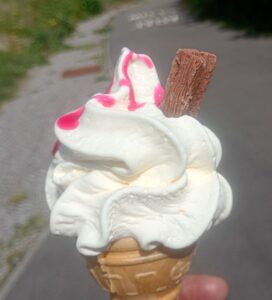
I start with a slow, gentle 8km that ends in our local country park. Easy. I reward my right knee with an ice cream.

17th March

I’m on my way home from Aberystwyth and get off the bus in Carmarthen to walk out to Llangain. This is flat but double the distance of last week at 15km. I stop thinking about my right knee when a man comes up to me in Llangain and demands to know my opinion of the Wales Coast Path signpost opposite Johnstown Leisure Centre. “It was pointing the wrong way,” I say. “I took no notice.” “ ‘Na fe!” he exclaims excitedly. “Months I’ve been telling the council but not for what they’ve done anything with it! Pointing back to town it is! Tell me, what made you ignore it?” “I’ve got a map and a compass and I know how to use both.” This reply sends him into raptures and as the bus pulls up, he says it has been a privilege to meet someone who knows how to walk properly. On the journey back to the railway station my right knee glows with self-satisfaction. Or possibly the start of arthritis.

24th March

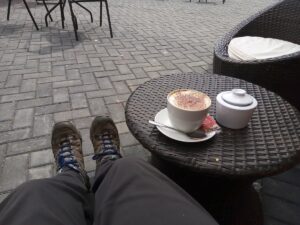
I get off a train in Pyle and walk home through Kenfig Hill, Bedford Park and Parc Slip Nature Reserve. 20km, all flat. There is no complaint from my right knee probably because I allowed it to have a sit down and a cappuccino at the cafe in Parc Slip.

31st March

I am overcome by the need for a new baking tray so walk to TK Maxx in Talbot Green. 23 km later and my right knee is a bit grumpy. That might be to do with the fact that I get a banana rather than an ice cream in the Co-op on the way home. Also I don’t find a baking tray that I like enough to buy. Disappointment all round.

7th April

I catch the train to Port Talbot and walk home. The A48 is tedious until Kenfig Hill and from there I repeat the route of 24th March but with the addition of a hot dog at the cafe in Parc Slip. 25km .

14th April

Train to Carmarthen to try out the new Tywi Valley route.  I walk to Llanarthne and back. I tell my right knee that we’ll have a Solero or Cornetto in the village while we are waiting for the bus but it turns out there’s no shop. When the bus arrives it has no passengers. I comment on this to the driver who says that no-one ever catches this bus and she’ll be stopping at the National Botanic Gardens to have a wee whether I like it or not as she doesn’t finish her shift for another 6 hours and although her bladder control is considered by her fellow bus drivers to be excellent, she doesn’t want to chance today being the day it is sub-standard. I understand why there are no passengers.

23rd – 26th April

I am working and walk 93km over 4 days. My right knee is deeply unhappy. My bank account on the other hand is smiling contentedly.

30th April

My last training walk is 24km downhill, flat, uphill, steeply uphill, flat, undulating, gently downhill, steeply downhill and flat. My right knee says it wants total rest between now and the big day or it won’t guarantee us getting back to the finish line before the tea tent closes and the ice cream van departs the field.

To be continued after the 10th May when this might or might not happen….

Waiting for the Right Moment

Even though I worked for the NHS I’ve never been far away from the world of Education.  Over the years I’ve taught, tutored, trained, coached or mentored people in all manner of subjects and regardless of their background or ability.  My experiences as an educator lead me to certain conclusions:

Context is everything

Firstly, remember the country before Austerity?  On Sundays buses used to leave many towns in South Wales and head for Brecon.  They’d all arrive at about 11am and leave at 4pm.  It was a great way to visit the Bannau Brycheiniog National Park without driving there.  I regularly caught one of those buses and had lovely times hiking stretches of the Monmouth to Brecon Canal towpath but thanks to George Osborne’s flawed approach to macro Economics and the consequent decimation of public transport services, the canal and I hadn’t seen each other in years.

Next, I think I am very easy to buy Christmas presents for.   This is because I produce a list of suitable gifts.  At the risk of seeming ungrateful I actively, loudly and repeatedly encourage present-givers to stick to this list.

Finally, I am a fan of Life Long Learning and since my first degree I have accumulated certificates and qualifications in a variety of subjects.  Some have been useful, some not.  Some have just been waiting for the right moment.

There are two types of people in the world – the ones who do what they’re told and the ones who don’t

Last year elder sister Nell and her husband decided they would be going to South Africa for a month in March 2025.  A house sitter who could take care of Molly the cat would be hired.  This arrangement failed to meet Annie’s standards.   Molly, she said, isn’t the sharpest pencil in the box and she doesn’t like strangers.  Neither of these comments could be disputed by Nell but not with much verve as she was too busy thinking about flights and AirBnBs.  Unhappy at such a laissez-faire attitude to Molly’s emotional welfare, Annie set about making her own plan and in December arranged to meet Nell in a café in Abergavenny.  Maria would come and stay in the house and look after Molly.  This solution would work because Molly never growls, spits at or scrams Maria and with nothing else to do Maria could write the book she has been putting off for much too long.  Meanwhile Nell wouldn’t have to worry about a potentially thieving, cat-hating psychopath in the house and because Maria would stay for free, Nell would save a shed load of money.  No, Maria didn’t know yet but she would do as she was told.

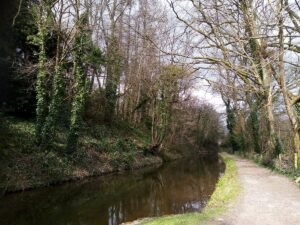
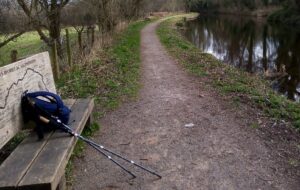
Which is how I come to be writing this – with a sleeping cat on my lap – in Nell’s house.  Being this close to the Monmouth – Brecon Canal has stirred some nostalgia so yesterday I caught a bus to Talybont on Usk to walk along the canal towpath like I used to in the pre-George Osborne days.

Time for another bit of context.  I made my Christmas list early last year and on hearing that Annie intended to go to Abergavenny, I gave her a copy.  It said “MARIA’S CHRISTMAS LIST – PLEASE BUY ONLY ONE OF FOLLOWING AND DO NOT GO OFF PISTE!”  Beneath was written: Jigsaw; Flask; Knitted Gloves (pink or yellow); Scarf (grey).  So  I was surprised on Christmas morning to unwrap a large parcel from Annie and find that it contained a red fleece jumper – especially as it was exactly the same as one that I had bought just a few weeks earlier when we had gone shopping together.  Once the fleece had been returned for a refund, I bought myself two new trekking poles instead which finally got tried out today.

As an aside, my old trekking poles had been bought in 2015 when I did an Ultra Marathon just south of Oxford the day after meeting the then Prince Charles in Aberystwyth.  I had got on the train in a flouncy dress and high heels and got off a few hours later in lycra shorts and trainers.  That’s a whole different story which we might get to one day but not today.  If there was one annoying thing about the old trekking poles – which even the heir to the throne didn’t know about because they weren’t allowed in the same room as him – it was that they were fixed length and therefore awkward to carry.  Over the years they have been bumped and battered, scratched and dented, straps have fallen off and they’ve worn through loads of ferrules.  The new trekking poles are telescopic and very smart.   In case you’ve never tried Nordic Walking, what you want is a nice flat surface like a canal towpath.

Education is never wasted

It was a lovely walk.  I passed or was passed by friendly hikers, runners, cyclists and dog walkers.  The only unfriendly person I encountered was a scowling woman with a wailing child in a pushchair.  A mile or so further down the path and I think I found the reason for the traumatised toddler.

In amongst those various certificates and qualifications I spoke of earlier is the one which was waiting for the right moment to be useful : the RLSS Bronze Medallion for Lifesaving.  One of the lessons I remember quite clearly is – if possible – don’t get into the water to rescue a casualty.  Use something that you can reach out towards them with; something that they can catch hold of so that you can tow them to safety.  A trekking pole, perhaps?

Epilogue

Yes, of course I rescued him.  He was a bit stinky but had a bath and spent several hours on a radiator to dry off.  I’ve called him Robbie after Robbie Cumming who presents Canal Boat Diaries on BBC 2.  I’ve knitted him a little jumper and pinned him into the pocket of my rucksack so he can come on adventures with me.


Oh Maisie

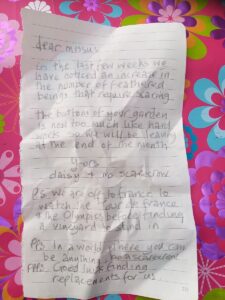
Years ago, when the legendary Terry Wogan manned the Radio 2 Breakfast Show, he invited  listeners to contribute endings to the phrase “You know it’s going to be a bad day when…”  One submission I recall was “you know it’s going to be a bad day when your child says Mum, did you know it was almost impossible to flush my teddy bear down the toilet.”  Now, I knew it was going to be a bad day when I got home a couple of weeks ago and found this note shoved through the letter box:

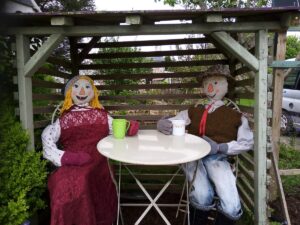
Daisy and Mo have been at the bottom of our garden for about 3 years and I don’t think them leaving has got anything to do with the increase in feathered beings we’ve had in the garden since Lily departed for the great cat basket in the sky.  I think it’s more to do with the fact that we’ve had a succession of wet and stormy winters.  They’ve been sat outside the whole time, developing mouldy rashes in all sorts of scarecrow nooks and crannies, so I can see why a warm and dry French vineyard might seem a better option.

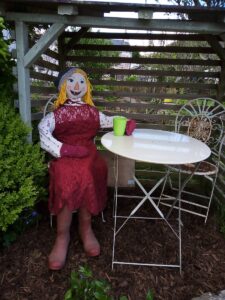
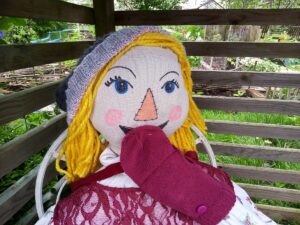
Anyway, true to the requirements of Scarecrow lore which decrees specific dates when scarecrows are allowed to wander, we got up on the morning of 1st of May to find the shed empty.  Advertisements to fill the vacancy had been posted in all the best fields and it wasn’t long before we’d appointed Maisie Corncockle.  Almost immediately her popularity was being indicated by beeping car horns from van drivers who were passing the garden and social media messages from adoring fans: “Wow – she’s a looker!” and “Will you bring her to Porthcawl so I can buy her hot chocolate with squirty cream?” being just two of the examples I had to stop Maisie replying to.

Were they disappointed I wonder to find that Maisie’s heart belonged to another?  Ptolemy Corncockle arrived last week and for a few days all seemed well.   The beans, peas and leeks are all planted and there has been no major crow activity so I was beginning to hope that the scarecrows might be effective and efficient members of staff.  Experience, however, tempers my optimism.

We have had scarecrows at the bottom of the garden for about 20 years and in that time they have proved themselves incapable of simply scaring crows.  They have appeared on television, been interviewed on the radio and featured in newspapers and magazines.  The first incumbents, Trevor and Lucille, were given notice to move on when they kept producing baby scarecrows and the shed simply couldn’t accommodate all the offspring.

Rowli and Cati Puw regularly received postcards from abroad, letters from local schoolchildren and anonymous presents including, once, a Christmas pudding in July.  Then Rowli was kidnapped one day by a man whose girlfriend had indicated she preferred Rowli to him.  Even though he was returned to the garden sitting in the back seat of a police patrol car (with his seat belt fastened), Rowli  never settled down again.  There have been other residents of the shed and none of them have been content to lead a quiet life and just do their job.  I have a feeling that there’s trouble brewing with Mr and Mrs Corncockle.   Only today I noticed that Ptolemy has turned his chair slightly so he can glare at the drivers who are being less than respectful to Maisie, like the chap this morning who went even slower than the 20mph limit and shouted “Hello Darling – dump him and come home with me!”

Oh, Maisie.

The Cucumber of Destiny

When I announced I was going to write a book lots of people – friends, contemporaries, academics, mentors, historians, craftspeople and writers – offered suggestions on what should be included.  If you were one of them, thank you.  Through you I disappeared down delightful rabbit holes of research and became completely distracted by early medieval Wales, heritage crafts and geopoetics.  My intention for part of the book was to wander around Pembrokeshire, describing what I saw in words and crafted illustrations.  What I failed to consider in this grand plan was cucumbers.

Llandissilio

The llan of Llandissilio church is still clearly defined as a low stone wall with a stepped cross-over stone alongside the porched gate.  Originally the site was an Iron Age enclosure but now the llan encircles a peaceful graveyard with a tranquil garden of remembrance.  In the south wall of the church are early medieval inscribed stones which luckily escaped the attentions of the Victorian renovators.  My route led from the churchyard towards the ford at Vicar’s Mill but after about a kilometre I turned left at the crossroads and strolled up a gentle slope passing old stone cottages, 1970s bungalows and posh new builds every few hundred yards – all of them set in the sort of garden that would put Monty Don to shame.

Becky

One of the things you notice everywhere in rural Wales is the entrepreneurial nature of gardeners.  At the first sign of a glut a table with produce and a sign to entice buyers is propped outside the garden gate.  I always stop and browse out of envy rather than interest because I live in a not so rural part of Wales where indicating that you are prepared to sell surplus vegetables is frowned upon by the local council.  I know this because I once sent them an email asking if I could put such a notice up when my summer harvest had gone into overdrive.  The very next day a power dressed young woman called Becky arrived and told me that as I would be in competition with the nearest supermarket – Sainsbury’s, about 2km away on the other side of the M4 motorway – I would have to adhere to the same legal requirements as them, vis:

  • Provide parking spaces for customers including separate, marked ones for the disabled and parents with children
  • Provide toilet facilities for customers
  • Provide hot and cold running water for people who wanted to handle the vegetables to assess their quality
  • Ensure that all vegetables were thoroughly washed in anti-bacterial liquid before and after the people assessing quality handled them

Sadly – for Becky and, it turns out, for the prospect of selling my surplus salad vegetables – I have a medical condition which is worsening with age.  It’s called Maturity Onset Intolerance of Stupidity Syndrome and the main symptom is that the filter between what I’m thinking and what comes out of my mouth now fails to operate.  So after I suggested that Becky took into consideration that I only had two – albeit productive –  cucumber plants, that the corner shop at the end of my road had no parking, toilets or hand-washing facilities for customers, that I grew everything organically so immersing the vegetables in chemicals would be counter- productive and that I thought most of the world’s problems could be laid fair and square at the door of supermarkets and the local government sycophants that empowered their policies of economic and environmental exploitation, I asked Becky what the council’s position was on dealing with excess cucumbers.

“Build a compost heap,” she said sweetly.

Back to Llandissilio


It was obvious that there were no Beckys in the lanes around Llandissilio.  I had passed multiple opportunities to buy eggs, honey and jam but the prospect of dealing with breakages in my lovely new rucksack was too horrible to contemplate.  Then I noticed a table in the front garden of a small whitewashed cottage and read the black felt pen scrawl on the back of a turned inside out Cornflakes box.   “CUCUMBRAU AR WERTH!” it said, “MONEY/ARIAN PAROD AM HEDGEHOGS!”  Then underneath as an afterthought, “I RESCUE HEDGEHOGS!”  I felt around in my pockets for a couple of coins, went in through the creaking gate and chose a fat, juicy-looking cucumber.  I thought it would make a thirst quenching afternoon snack which wouldn’t break, smash or otherwise ruin my rucksack and my day.  The glum face of the old man who was sitting inside the house staring out of the window at me suddenly broke into a toothless smile of utter delight and I felt guilty as I looked at the collection of shrapnel I’d chucked in the empty margarine box on the table.  I searched my pockets again, drew out a two pound coin and dropped that in the box too.  This sent Mr Toothless into paroxysms of joy and while it turned out to be a relatively expensive but delicious cucumber, my purchase brought us both a level of pleasure and satisfaction that no-one ever gets from Sainsbury’s.

Epilogue


I’m sorry to disappoint all the encouragers and supporters of my book who wanted me to only write about early medieval Wales or about heritage crafts or about geopoetics.  I really did try to take a serious approach but the long and short of it is that I find the people I meet on my walks through Wales are interesting, entertaining and often, downright weird.  I think my destiny is to share those anecdotes so they’re going to get a section in the book as well.  And if you’re wondering what happened to my own harvest surplus, as soon as Becky left I put a crate of cucumbers on the village bench with a cardboard sign saying “FREE!”  Within an hour they had all gone and no-one had asked for parking, toilets, hand-washing facilities or anti-bacterial vegetable wash.

The Fig Issue

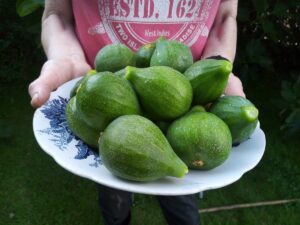
It’s harvest time at Scarecrow Cottage.  This means long days of picking and preserving, climbing up ladders with empty bowls and climbing down ladders with full ones.  The weird weather this year has disrupted the normal growing patterns – our sweetcorn and peas are virtually non-existent but the beans look as if they’ll still be growing well into the autumn.  And then there are the figs.  Dear God, are there figs.

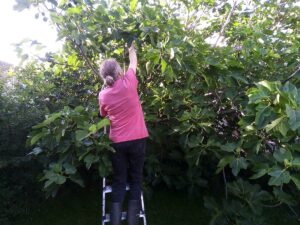
The 2 fig trees (Scott and Virgil) are 3rd or 4th generation descendants of a sapling that arrived in a neighbour’s suitcase after he had been to visit family in Croatia back in the 70s.  Clearly they like a south facing garden in Wales more than they like the coastal karst of Dalmatia because not only do they produce a lot of fruit but they also grow into very big trees – very, very big trees.  The care, cropping and distribution of fruit from the fig trees form part of Annie’s job description.  In early spring she pruned Scott so radically that most people thought she’d condemned him to a slow death.   There have however been two less terminal results from her extreme arboriculture: firstly Scott’s bare, stumpy branches have become a magnet for every passing pigeon in the area and secondly, Virgil – presumably desperate to avoid Scott’s fate – has overcompensated in the amount of fruit he has produced to the extent that Annie has sourced scaffolding to allow her to pick from the higher branches.

But let’s deal with the pigeons first.

Tuesday 22nd August.

7am Annie goes out to feed the livestock and as usual, in flagrant disobedience of rat ingress prevention rules, leaves the door to the house open.

7.05am Annie re-enters house and screams “Sh*tting H*ll!” scaring herself and Lily the cat (who at an advanced 16 years old is now firmly and happily living in La-La Land).  The shout has no discernible effect on a pigeon who is sitting on the living room sofa as if he owns the place.

7.15am I arrive on scene.  The pigeon has been named Jimmy.   I’m not sure why but over the years I have learnt that accepting there are mysteries behind some of the happenings at Scarecrow Cottage is often the best path to take to inner peace.  Lily has been unceremoniously ejected as she was found affectionately licking the pigeon’s face and although Jimmy was not that bothered by his close proximity to a previously feather loving predator, caution was indicated.  It turns out that Jimmy is a racing pigeon so I am required to write down the ID and telephone number on his foot rings so Annie can arrange a rescue.  She has experience of doing this sort of thing from a few years ago when a racing pigeon called WC flew into a tree in the garden and sustained brain damage.  At the request of Juan, the Spanish owner who lived in Yorkshire, WC was taken to the local Vets’ for a neurological assessment but sadly he died just before the bill ran into four figures.  Anyway, that’s another story so let’s go back to Jimmy.  Jimmy was given a dish of corn for breakfast, had a selfie taken with Annie and then was put in a cage while contact was made with his owner.

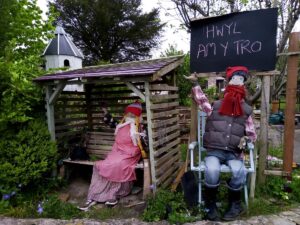
11.30am  Annie has left the premises to baby sit a paralysed dog while its owner takes a basket of figs to Terry Walton the gardening guru.  I don’t think Mr Walton had indicated any desire for figs but losing control over life decisions is often the price of fame.  I have been deputised to wait for Derek*, Jimmy’s owner who is on his way from Trefforest*.  Annie has sent me a text to say that Derek’s sat nav is not working so I will need to be at the bottom of the garden waving to any passing motorist who looks lost.  I have a better idea and make use of the scarecrows’ blackboard.  This has its desired effect and pretty soon Derek arrives.

11.45am I have learnt a lot about racing pigeons.  Derek says that the fact that Jimmy’s ring is white indicates that she is female.  I ask what her name is.  Derek turns Jimmy upside down and says E243168.  I say my sister gave Jimmy some chicken corn.  Derek is not keen on chicken corn as nourishment for racing pigeons.  I comment that Jimmy seems very tame.  Derek replies that her mother is also friendly and given to riding around the shed on Derek’s shoulder.  Derek says that Jimmy’s father is the Blue who is calm.  If Jimmy’s father had been the Pied Cock, Jimmy would have ripped my sister’s face off.  I wonder where Jimmy had come from.  Derek had entered her into a race which started in Epsom in Surrey on the day that Storm Betty made landfall in the South West and rattled ferociously through a great swathe of England en route to the North Sea.  Many pigeons, Derek admitted sadly, had not returned home.  Only this morning he’d had a message from a man in Liverpool about one of his birds who had landed in Anfield.  Derek had offered to send a courier but the Scouser said he’d keep the pigeon for a couple of days and feed it up before letting it go to have another attempt at making it back to South Wales.  Derek is grateful for people like Annie and the man from Liverpool but says pigeons are not doing well these days because of mobile phones.  I have now got an image in my head of birds sitting outside cafes texting each other rather than racing home and I can’t unsee it.

As for Virgil and the fig glut, in addition to our freezer being full to bursting point we have been offloading fruit onto friends, family, neighbours and occasionally, random strangers (and I’m not talking about Derek, who was fig resistant).  I have now developed a new business strategy called Figonomics.  We don’t accept coin of the realm so this year, figs have been exchanged for scaffolding (see above), a pot of redcurrant & apple jam, fresh tomatoes and cucumbers, perennial flower plants, the hedge in the front yard being cut, an aerial gymnast who fearlessly climbed the scaffolding to pick a day’s crop, a free car wash, a wicker basket and 6 ground post spikes.  If only someone produced a cuddly toy it would be like a Good Life version of the conveyor belt in The Generation Game.

Wednesday 23rd August.

10am  In the past two hours Annie has had 3 increasingly irate voicemail messages from a posh sounding woman who says she’s ringing from London.  The last one is bordering on hysteria and goes like this:  “This is LITTLE Bluebells NURSERY.  We NEED you to RING us BACK NOW!!!  We NEED to know if YOU still WANT the PLACE that YOU RESERVED FOR ORLA!!!! RING US BACK NOW!!! WE CAN’T KEEP WAITING FOR YOU!!!!”

“What do you think?” says Annie.  “Is it spam?  Oh, I know how to find out.  I’ll ring her and ask if she wants some figs.  If she’s really from London, she’s bound to say yes.  If she’s a spamming bot, she won’t know what to say.”

“What about Orla?” I ask.

“Stuff Orla,” says Annie pressing the keypad numbers on her phone.  “Getting rid of the figs is more important.”


*Names and locations have been changed to protect the innocent.

There must be an easier way

Yes, I could have taken the car but I fancied an easy journey so instead I booked an advance ticket on the 6.50am train from Bridgend to Tenby (arrival time, 9.29am).  And because I did this 5 days before travelling and because I used the Senior Railcard I bought myself as a birthday present last year, my single ticket was £6.60 instead of the on-the-day price of £20.20.   If I’d taken the car, it would have cost me more than £25 in petrol and parking.  So far, so incredibly clever of me, I thought.  But as we all know, a smug attitude and public transport don’t go together.  I got to the station at 6.40am to find the words I least wanted to see on the Arrivals board:  “Pembroke Dock – Delayed”.  With the sort of Zen resignation that relying on public transport brings to your inner self, I watched the board switch to and fro between “Pembroke Dock – Expected (7.10am, 7.15am, 7.18am, 7.23am, 7.28am)” and “Pembroke Dock – Delayed”.  Every few minutes – in between the reminders not to smoke, use skateboards and do various other naughty things on the station premises – the words of automated announcements about the non-appearance of the 6.50am train rubbed salt in the wounds of those of us who just wanted a day out in Tenby.

At one point the loudspeaker crackled into life with the voice of an exasperated station employee:  “This is for passengers awaiting the 6.50am Pembroke Dock service.  The delay is because the train is currently on the platform on Cardiff Station.  Unfortunately, the driver isn’t.  He’s still in the depot. Transport for Wales is sorry about this and apologises to you all.”  Now call me a bit of a Luddite but listening to the sound of a human reaching the end of his tether is a much more satisfying experience than hearing some tinny computer generated voice reeling off empty apologies about inconvenience caused.   The train finally arrived at 7.30am and we trundled off through Swansea, Llanelli and Carmarthen eventually getting to Whitland (where the line branches) at about 9.40am.  In the ideal but somewhat unrealistic world of train timetables, this should have meant that I would arrive in Tenby at about 9.55am – only 25 minutes late.  This small burst of optimism was soon smothered  by more unwelcome words.  “Passenger announcement,” said a depressed sounding man over the Tannoy.  “Ladies and Gentlemen, I’m sorry about this because I know how long this service has been delayed but sadly I have to inform you that we are now going to leave Whitland Station, travel about 400 metres down the track then reverse back into Whitland Station so that we’re on the other side of the platform.  Then we’re going to stay here until 10.15am.  This is because there’s a train heading towards us from Pembroke Dock and we’re on a single line track.  I’m sorry.  I really am.”

Bless.  You don’t get that level of empathy from algorithms, do you?

Anyway, we eventually got to Tenby (packed to the rafters with tourists, as usual) at 10.40am.  My intention was to walk to Saundersfoot on the Wales Coast Path.  It was my first time to do this stretch and if you’re thinking you might want to try it, let me warn you not to bother unless you are physically fit, have knee cartilage made of rubber and you’ve got good tread on your shoes rather than a flat, shiny nothing that will have you slipping all over the place just because you’ve been too mean to buy new footwear.   To deter you more, parts of the path are so steep that steps have been cut into the slope so it’s more like climbing a ladder than hiking.

I’m going to illustrate this for you by a bit of racial stereotyping but before you think I’ve gone all right wing, let me say that my observations are tempered by me doing a lot of research on early Medieval Britain at the moment.  Hikers, in case you didn’t know, are a friendly bunch who pause to use conversation as a way of resetting a stressed cardio-vascular system without losing face.  You can spot the locals out rambling on the Wales Coast Path because they are all descended from Yoda.  They say things like “Climbing straight up, it is!” which sounds backward but is actually Welsh spoken through the medium of English; Norse folk with northern accents and doughty attitudes are generally “Aye, it’s a bit steep here,” whereas the Anglo-Saxon southerners are more easily danted:  “There’s a worse bit coming up – I’d turn back now if I were you.”  Then there are the Normans, with their brief “hello” and averted eyes, who don’t want to engage because they’ve never come to terms with the fact that they only ended up in charge after one bloke in a field looked up at the wrong moment.

All of this was tumbling around in my head as I tackled an uphill section that was closer to vertical than anything that I’ve done before, anywhere.  It was probably about 70 steps that angled around a couple of twists and turns.  By step number 53, my lungs were running red hot and begging for mercy.  I stood off to the side of the path to let a blonde woman coming down the pseudo-ladder pass me.   She was relishing the descent.

“It’s harder going up than coming down,” I gasped, trying for a friendly smile at the same time.

“No! No! No!”  Blondey snapped back.  Was that a Scandinavian accent? Who let the Vikings in?  “For the lungs going up, it is nothing.  For the knees coming down, that is the true pain.  That is the agony.  This you will find out if you ever come back to Tenby.  It would be wise for you,” her finger jabbed the air in my direction, “to find another way.”  She looked at me still in a state of respiratory distress and added – with unnecessary candour, I think – “an easier way.”

So I did.

PS Transport For Wales refunded my £6.60 train fare.

A Perilous Pastime

I met someone from Devon recently who was unhappy about the Brecon Beacons National Park changing its name to Bannau Brycheiniog.  She resented the alteration because the English was – well, English –and because the new/old version was yet another example (she said) of the “uppity attitude” of modern day Wales.  Here in Morgannwg we have an uppity attitude because most settlements are in the valleys and to travel in any direction other than south you have to go up and over the nearest mountain.  My walk last Sunday started from Blackmill with a very steep climb up some steps that had been cut into the hillside; so steep, in fact, that I needed a couple of minutes at the top to get my breath back and make sure that my legs weren’t serious about their threat to go into spasms of cramp.  And that made me think about how rambling can be a perilous pastime.

I got my love of walking and maps from my dad.  Every winter we would head up onto the moors near Brecon to look for snow (for me) and to stop for a fried breakfast at the Mountains Café (for him).  Eventually I reached the stage where I wanted to walk further and alone so snow and fried breakfast expeditions with Dad became just another happy memory.  A few years ago (and – excuse alert – before I had started to learn Welsh) I decided to do a long distance challenge walk in the Cambrian Mountains.  Anticipating that I wouldn’t feel like driving home after a 30 mile yomp, I persuaded my sister to take me.  She intended to have a lazy day mooching around the shops and tearooms of Llanwrtyd Wells.  It was the middle of summer, the weather was perfect and the route was gorgeous.  Even so 30 miles is 30 miles and by the time I got back to Walk HQ, my legs were screaming.

“Glad you’re back safe,” said the event organiser as I booked in. “Your sister’s had an accident.  She’s broken her foot.  She dropped an industrial typewriter on it.  She’s waiting for you by the river.”

It didn’t take long to find Annie because she was the only person sitting in the river rather than by it.

“I broke my foot,” she announced.  “Do you have any idea how heavy industrial typewriters are?”

“I do actually,” I said.  “How did it fall on your foot?”

“Because some patronising blokes at the auction offered to carry it to the car for me.  I said to them, I said – I’m an orthopaedic nurse.  I lift patients twice as heavy as this without help.  So to prove it, I picked up the typewriter and took it to the car but I when I went to put it in the boot, it slipped sideways and then it fell.  My foot was underneath.  I can’t drive you know.  You’re going to have to take us home.”

There was, at this point, a choice of questions: which blokes?  What auction?  Why bid for a typewriter at all, let alone an industrial one?  In the end I asked why she was sitting in the river.

“Because my foot is broken and the cold water will stop the swelling.”

“Yes, but you’re sitting down in the river.”

“I couldn’t stand.  Like I said, my foot is …”

“Broken.  I know.  Is it though?  Really?”

“It feels like.  I haven’t taken my shoe off in case my toes have been traumatically amputated and they float away downstream.  Anyway, help me up.  I want to go home.”

And so it was that we started the drive back down the A470.  After about an hour with the heater on full blast and the windows wide open to prevent steam forming, most of Annie’s trousers had dried off.  By this time we were both hungry so stopped at the Mountains Cafe which had now changed its name to Cartref Mynyddoedd.  When we got out of the car it became clear that only the front and legs of Annie’s trousers had dried – her backside was still (literally) dripping wet.  My body, meanwhile, had developed a post 30 mile walk rigor: knees refused to bend and hips had seized up completely.  We were a bit of a sight as we crossed the car park.  Each of my legs took it in turn to swing forward in an ungainly arc with me unable to stop myself from yelping as blistered feet hit the ground; Annie had one hand on my shoulder to balance herself as the broken foot refused to cooperate in any form of weight bearing.  Every time we paused, a little bit of the river Irfon puddled to mark the spot.  We staggered and squelched into the café which was surprisingly full for 6 o’clock on a Sunday evening.  We spotted an empty table on the far side of the room.  With a lot of excusing and apologising, we pushed and manhandled our way past seated diners until we collapsed into chairs making loud and unselfconscious grunts of pain.

A waitress arrived.

“Can I help you?”

“Have you got a menu?” said Annie.  “No, forget that.  I’ll have anything with chips: sausage, peas and chips but without peas or ham, egg and chips but without an egg.”

“Are you a resident?” said the waitress.

“No.”

“Then I’m sorry but you can’t eat here.  We’re not a café, you know.”

“Yes, you are,” I said taking on the know-it-all persona that I am renowned for.  “I used to come here with my dad.  He always had fried breakfast.”

“That would have been a few years ago then.  Before we became Cartref Mynyddoedd Nursing Home.”

I glanced around.  We were being stared at by a roomful of open mouthed octogenarians.  I wish we could say that we made a discreet and dignified exit but alas, that was beyond us and particularly it was beyond Annie, who stopped at several tables to tell people about her broken foot and the dangers of buying industrial typewriters at auctions in Llanwrtyd Wells .

Epilogue.

1              I spend a lot of my days driving up and down the A470 and never a trip to Brecon goes by without me feeling a little twang of nostalgia/embarrassment/shame as I go past Cartref Mynyddoedd.

2              Annie had bought the industrial typewriter as a present for me because she had remembered me saying something about a typewriter a couple of weeks earlier.

3              The something I had said was “I’ve bought a Word Processer and given my old typewriter to a charity shop.”

4              Annie gave the industrial typewriter to someone she knew who sold it in a car boot sale for 50p.

5              Wales is a bilingual nation.  The sooner you learn a bit of the language, the better.  Let me help you out:  Café – Caffi  ; Home – Cartref.

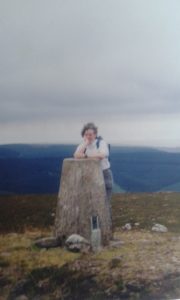
My first trig point