Doughnuts

Last night BBC4 showed a complete rerun of the 1974 Eurovision Song Contest and I wallowed in nostalgia.  Weirdly the 1970s seem both like yesterday and like a really long time ago: yesterday because I recalled the songs so clearly but a long time ago because the angst of teenage years has faded and I can view most of the events that made me the person I am through a distinctly rosy hue.   I studied Economics and British Constitution at A level with the aim of doing a related degree.  The story of how that didn’t go as planned is for another day but for the moment let’s just accept that I have witnessed the Westminster shenanigans of the past few years with the objectivity of someone planning her next essay.  In the years since I didn’t go to Swansea University to study for a BA in Economic & Social Studies and instead ended up doing a B.Ed in Home Economics at Cardiff, I have come to think that the future for most of us – ie, the ones who don’t have gazillions of pounds, euros or dollars in off-shore banks – lies in being budget conscious consumers who buy smart, not more.  All of which brings us to doughnuts.  This is probably a huge relief to those of you who are more interested in cakes than the production and distribution of wealth.

Cardiff 1976 – 1979

There were no lectures on Wednesday afternoons so my pals and I used to catch the number 25 bus from Llandaff to Cardiff city centre.  We’d get off at the castle and work our way up Queen Street.  The first shop was Marments with its immense communal changing room and no restriction on how many clothes you could take in with you to try on.  There didn’t seem to be much shoplifting in those days but I know for a fact that Marments had been the victim of some criminal activity.  Roll back a couple of years to when Mr Williams had arranged a trip for his British Constitution A level students to see judicial processes in action.  Our class sat in the public gallery of Cardiff Crown Court to witness the case of Regina vs some chap who’d been caught by the rozzers as he climbed down Marments fire escape with a load of fake fur jackets in his arms.  In his defence he said that he’d  gone up onto the roof to get a better appreciation of Cardiff’s night sky, had found the jackets in a pile near a broken skylight and was on his way to hand them in at Cathays Police Station.  We had to leave before the verdict but I often wonder if the jury believed him.

Next stop for us was Laura Ashley with its iconic desire to make us all look as if we’d walked off the set of Oklahoma.  After I was ejected from the Food & Nutrition course at college for falling asleep in a 2 hour lesson about the mechanics of slicing an onion and forced into studying Textile Art instead, I found that my new lecturers expected students to dress with a little more creativity than the white overalls which were de rigueur in the kitchens.  I embraced this philosophy – mostly because I was still traumatised by my mother once deciding that Annie (9) and I (11) should wear matching clothes.  OK, it only happened on a single occasion but that was enough.  I have always had the body shape of a not quite fully inflated Michelin tyre man and in her youth Annie was more like a member of Stickman’s family, all spindly legs and twiggy arms, so putting us both in dark brown trousers and cream jumpers was never going to work.  On an outing to town a woman in Barclays Bank looked us up and down, said to Mum “twins?” and then without waiting for an answer jabbed a finger in my direction and demanded “have you been eating your sister’s food?”

So is it surprising that as an adult I found calf length skirts showing ruffles of petticoats, Fair Isle socks and ankle boots to be cathartic?  The Laura Ashley look in those days was easily copied by cash strapped students who didn’t trust their mothers to buy clothes for them.

Our final destination was British Home Stores where there was a food hall selling doughnuts dusted in vanilla fragranced icing sugar that floated in clouds as the shop assistant picked them up with tongs to put in paper bags.  Also if you got to BHS at about 4.15pm doughnuts were reduced to half price and as tea in the college refectory wasn’t until 6.30pm on Wednesdays, this meant that you could eat one walking back to the bus stop, one on the bus and have one to eat in the common room at 9pm.
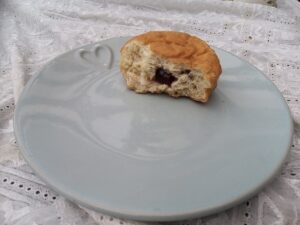
When Kate Raworth published the theory of Doughnut Economics as a model for sustainable development, it was not met with universal love and admiration by Capitalists but it made total sense to folk who worry about the future we are leaving for the next generation.  The hole in the doughnut represents people who don’t have access to fundamentals like enough food, water, education etc. while the outside crust is the finite nature of a healthy environment; the cakey bit is humanity being part of a fair and just economy.  I think about the people with the gazillions in the off-shore banks that they’ve made at the expense of others and/or the planet and I think about me spending a Sunday evening being very happy because I still remember the lyrics to “I see a star” which wasn’t even the winning song in 1974.  Then I think of how if Kate had come up with her theory fifty years ago instead of in 2012, I could have written a cracking essay, passed the A level I failed and gone to Swansea University.  But I’d never have become a Textile Artist, never done a degree in Creative Writing and never got in the habit of writing blogs.  Mind you if I hadn’t written this particular blog I wouldn’t have had to buy lots of doughnuts to illustrate it and I wouldn’t now look like a fully inflated Michelin tyre man because I didn’t want to waste them.

The Cucumber of Destiny

When I announced I was going to write a book lots of people – friends, contemporaries, academics, mentors, historians, craftspeople and writers – offered suggestions on what should be included.  If you were one of them, thank you.  Through you I disappeared down delightful rabbit holes of research and became completely distracted by early medieval Wales, heritage crafts and geopoetics.  My intention for part of the book was to wander around Pembrokeshire, describing what I saw in words and crafted illustrations.  What I failed to consider in this grand plan was cucumbers.

Llandissilio

The llan of Llandissilio church is still clearly defined as a low stone wall with a stepped cross-over stone alongside the porched gate.  Originally the site was an Iron Age enclosure but now the llan encircles a peaceful graveyard with a tranquil garden of remembrance.  In the south wall of the church are early medieval inscribed stones which luckily escaped the attentions of the Victorian renovators.  My route led from the churchyard towards the ford at Vicar’s Mill but after about a kilometre I turned left at the crossroads and strolled up a gentle slope passing old stone cottages, 1970s bungalows and posh new builds every few hundred yards – all of them set in the sort of garden that would put Monty Don to shame.

Becky

One of the things you notice everywhere in rural Wales is the entrepreneurial nature of gardeners.  At the first sign of a glut a table with produce and a sign to entice buyers is propped outside the garden gate.  I always stop and browse out of envy rather than interest because I live in a not so rural part of Wales where indicating that you are prepared to sell surplus vegetables is frowned upon by the local council.  I know this because I once sent them an email asking if I could put such a notice up when my summer harvest had gone into overdrive.  The very next day a power dressed young woman called Becky arrived and told me that as I would be in competition with the nearest supermarket – Sainsbury’s, about 2km away on the other side of the M4 motorway – I would have to adhere to the same legal requirements as them, vis:

  • Provide parking spaces for customers including separate, marked ones for the disabled and parents with children
  • Provide toilet facilities for customers
  • Provide hot and cold running water for people who wanted to handle the vegetables to assess their quality
  • Ensure that all vegetables were thoroughly washed in anti-bacterial liquid before and after the people assessing quality handled them

Sadly – for Becky and, it turns out, for the prospect of selling my surplus salad vegetables – I have a medical condition which is worsening with age.  It’s called Maturity Onset Intolerance of Stupidity Syndrome and the main symptom is that the filter between what I’m thinking and what comes out of my mouth now fails to operate.  So after I suggested that Becky took into consideration that I only had two – albeit productive –  cucumber plants, that the corner shop at the end of my road had no parking, toilets or hand-washing facilities for customers, that I grew everything organically so immersing the vegetables in chemicals would be counter- productive and that I thought most of the world’s problems could be laid fair and square at the door of supermarkets and the local government sycophants that empowered their policies of economic and environmental exploitation, I asked Becky what the council’s position was on dealing with excess cucumbers.

“Build a compost heap,” she said sweetly.

Back to Llandissilio


It was obvious that there were no Beckys in the lanes around Llandissilio.  I had passed multiple opportunities to buy eggs, honey and jam but the prospect of dealing with breakages in my lovely new rucksack was too horrible to contemplate.  Then I noticed a table in the front garden of a small whitewashed cottage and read the black felt pen scrawl on the back of a turned inside out Cornflakes box.   “CUCUMBRAU AR WERTH!” it said, “MONEY/ARIAN PAROD AM HEDGEHOGS!”  Then underneath as an afterthought, “I RESCUE HEDGEHOGS!”  I felt around in my pockets for a couple of coins, went in through the creaking gate and chose a fat, juicy-looking cucumber.  I thought it would make a thirst quenching afternoon snack which wouldn’t break, smash or otherwise ruin my rucksack and my day.  The glum face of the old man who was sitting inside the house staring out of the window at me suddenly broke into a toothless smile of utter delight and I felt guilty as I looked at the collection of shrapnel I’d chucked in the empty margarine box on the table.  I searched my pockets again, drew out a two pound coin and dropped that in the box too.  This sent Mr Toothless into paroxysms of joy and while it turned out to be a relatively expensive but delicious cucumber, my purchase brought us both a level of pleasure and satisfaction that no-one ever gets from Sainsbury’s.

Epilogue


I’m sorry to disappoint all the encouragers and supporters of my book who wanted me to only write about early medieval Wales or about heritage crafts or about geopoetics.  I really did try to take a serious approach but the long and short of it is that I find the people I meet on my walks through Wales are interesting, entertaining and often, downright weird.  I think my destiny is to share those anecdotes so they’re going to get a section in the book as well.  And if you’re wondering what happened to my own harvest surplus, as soon as Becky left I put a crate of cucumbers on the village bench with a cardboard sign saying “FREE!”  Within an hour they had all gone and no-one had asked for parking, toilets, hand-washing facilities or anti-bacterial vegetable wash.

Never Say Never

Hands up who remembers what we agreed after last year’s fundraising effort in aid of Crisis?  Yes, that’s right, we said – and I quote – “We are never, ever doing a Yard Sale again!”

Saturday September 9th

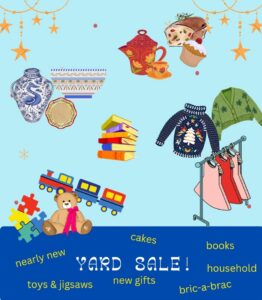
I am doing my usual voluntary stint at Porthcawl parkrun until 10.30am but then going somewhere to do something approximating a job.  This takes much longer than I anticipate so I message Annie to say that I won’t be home until after 5pm.  “No worries!” comes back a text followed by several emojis laughing hysterically and one whose skull is blowing off the top of its head.   On the spur of the moment, Annie decluttered the entire house and had a pop up Yard Sale, announced to passing motorists by chalky scrawl on a giant blackboard tied to the garden fence.  When I get home that evening, Annie confesses she told everyone who came – and, not surprisingly given we live on a main road with a lot of traffic including 6 buses an hour (3 in each direction), there were a lot of visitors – that there would be another Yard Sale for Crisis before Christmas and next time, she’d make sure there’d be cakes for sale.


Sunday September 10th

We sit down and have a serious chat and decide that maybe a smallish fundraiser rather a repeat of last year’s chaos is in order.  I agree to see if anyone would like to pay to adopt one or two of the preloved teddy bears I mend;  Annie thinks it would be a good idea to do a table top sale with some more of her junk  – sorry – ephemera .


Friday September 29th – Sunday September 23rd

I am working away from home.  On Friday Annie goes to a nearby town on the bus to assess a Friday morning Table Top Sale.  She decides this will not be a suitable venue for her junk  – sorry – ephemera.  On Saturday she hears someone on television say the words “Go Big or Go Home”. This phrase takes root and grows inside her brain until she completely forgets our conversation of Sunday 10th September.  She makes the most of me being in another part of Wales to send messages to everyone she knows asking them for anything and everything they do not want so she can sell it at a Yard Sale in aid of Crisis.

Saturday 7th October

Annie sets the time & date of the Yard Sale as 12pm – 4pm, Sunday 10th December.  I suggest that at roughly the same time we offer 20 friends the opportunity to sit in front of our 3 lit log burners and have tea, coffee and home-made cake for £5 a pop.  Annie thinks this is the most ridiculous idea I have ever had.

Saturday 14th October

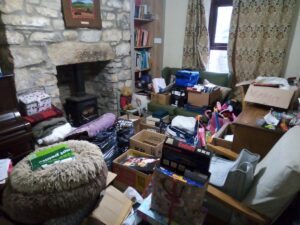
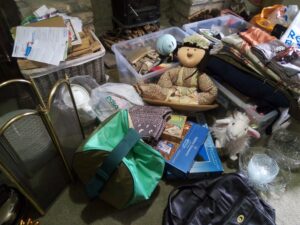
The spare bedroom is now full of everyone else’s junk – sorry – ephemera.

Thursday 18th October

While I am working in the garden, Annie decides to polish the log burner in the living room using HotSpot Stove Paint.  Annie comes down the path and says tearfully that she didn’t want us to be ashamed of the state of the log burner if we had visitors but if she had realised that the base of the tube would burst open shooting a thick black oily gunge across the room so that it landed in permanent, never to be removed, splatters all across our new-ish pale grey carpet then, yes, she would have put newspapers down first.  I am not that bothered by this report for three reasons: firstly, the new-ish pale grey carpet was not my choice; secondly, somewhere in the spare bedroom under the junk – sorry, ephemera – is a large rug I bought some years ago; thirdly, you don’t get to mine and Annie’s age – especially after a working life in the NHS – without knowing that there are worse things in life than a paint stained carpet.  However, Annie doesn’t usually weep over soft furnishings so I sum up my feelings by shrugging and saying “It’s only stuff.”  Annie thinks I am amazing and buys me a bag of chocolate buttons.

Friday 19th October

Now that the HotSpot Stove Paint has dried completely, the incriminating evidence is covered by the rug that we liberated from the spare bedroom.

Wednesday 25th October

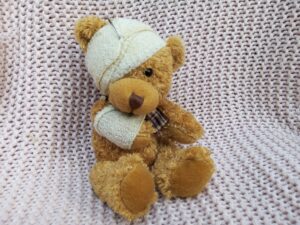
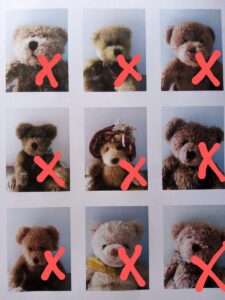
Last Saturday at the Makers’ Market in Rhondda Heritage Park, Ruby the teddy bear was adopted by someone who gave me a donation for Crisis.  I know from experience that the people who I interact with on Twittex are – in spite of their intellect, job titles and academic persuasions – slightly but joyously bonkers so at 7.52pm I tweet that Scarecrow Cottage Hospital is having a mass discharge of patients and post this picture.

By 8.27pm, the status is this and we have made about £75 for Crisis.

Saturday 28th October

The second reception room is now full of everyone else’s junk – sorry, ephemera.

Tuesday 7th November

I send messages inviting 20 friends to a Log Burner Experience Afternoon with tea, coffee and home-made cakes for £5 a pop.  Places sell out within 2 hours.

Monday 20th November

We set our original fundraising target at £150 and as I write this our Just Giving Page stands at £325.  Latest research shows that a large proportion of the population are just one payslip away from becoming homeless so this is a cause that resonates with most folk.  Annie and I have a joint income that doesn’t even meet the bottom rung of what constitutes poverty to this government so we can’t make cash donations to charities like Crisis.  We do, however, have a garden with a yard, a house that can seat 20 people and friends who, year after year, ridiculous idea after ridiculous idea, turn out to support us and whichever good cause we land on.  If you can be anything in life, be a friend like that.  And don’t worry about stains on the carpet – they’re a lifestyle choice.

Sticky Betty

“What’s the matter with you?” demanded Annie this morning over breakfast.  “You’re all quiet.”

“I’m thinking.”

“About what?”

“This year’s Advent Calendar.  Last year I took photos of Smudge the unwanted toy rabbit in lots of different places I visited and posted one on Twitter every day in December; I did much the same with Aneurin the abandoned teddy bear in 2021.  I’m just wondering who should star in this year’s calendar.”

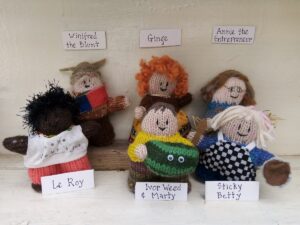
“What about them?” said Annie, waving a piece of buttery toast in the direction of the dresser where a collection of small knitted dolls stare blankly across the room.

“What, all of them?” I said.  “I can’t wander around Wales arranging that lot on castle walls.”

“Not all of them,” replied Annie.  “Just her on the end.  She’s famous already.  And no-one wants to see ruins.  They’re boring and in the middle of winter, they’re depressing too.    People want pictures of cafes and tearooms: cooked breakfasts of crispy bacon and fat sausages, glistening mushrooms, shiny red tomatoes, perhaps some baked beans but definitely no egg; or golden scones with little pots of strawberry jam or raspberry at a push but absolutely not blackcurrant; or those fabulous brie and cranberry melts with the lovely salad they do in The Potting Shed.  Like I said,”  Annie stood up and brushed her toast crumbs all over the floor, “if you’re going to do an advent calendar, you should realise that you’re the only person in the world interested in piles of stones.  The rest of us like food.”

Sticky Betty – A biography

The knitted inhabitants of Woollyton made their first appearance in May 2020 (In all our dreams ) when lockdowns were strict and humour was in short supply.  They starred in a sequel the following month which you can read here (The Mystery of the Missing Marshal)and then just before Christmas 2020 they emerged again from their world of knittiness to fundraise for the local foodbank.  After that I retired them and all would have been well except that Sticky Betty the eccentric and slightly wayward village cook saw an opportunity in the cost of living crisis to share her tightwad meal planning philosophy.  This year she has been pushing her way back into the limelight by occasionally sending recipes to the Baobab Bach Community Pantries website.

Owner of The Sticky Bun café and seller of anything which can be baked using free or at the very least, cheap ingredients, Betty is on a mission to put global brands of convenience food out of business.  And whilst she’s on her soap box, she would like everyone to know that if you are going to treat yourself to eating out occasionally, most small local cafes and bakeries cook proper food made from proper ingredients served on proper plates instead of splodged unidentifiable meat bits from the other side of the world that are wrapped in paper or sealed in plastic before being slapped on the counter for you to take away.   If you fancy trying some of Sticky Betty’s recipes, here are 3 for you to download and/or print.

Sticky Betty’s Cheese and potato pie

Sticky Betty’s Fluffy Blueberry Pancakes

Sticky Betty’s Spicy Stir Fry August 2023

Meanwhile if you’re out and about in South Wales between now and December and spot a woman who should know better positioning a small knitted doll in front of a big cream cake and a mug of cappuccino, that’ll be me.  Sticky Betty’s Advent Calendar will only be available on my social media unless some publishing company knocks on my door and offers me a large amount of money for the rights, most of which I will probably have spend on signing up to a weight loss programme in January.

The Fig Issue

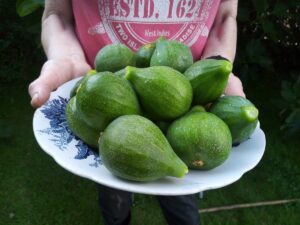
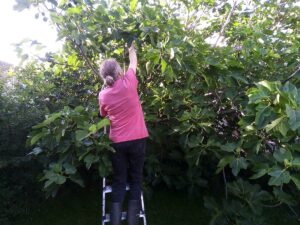
It’s harvest time at Scarecrow Cottage.  This means long days of picking and preserving, climbing up ladders with empty bowls and climbing down ladders with full ones.  The weird weather this year has disrupted the normal growing patterns – our sweetcorn and peas are virtually non-existent but the beans look as if they’ll still be growing well into the autumn.  And then there are the figs.  Dear God, are there figs.

The 2 fig trees (Scott and Virgil) are 3rd or 4th generation descendants of a sapling that arrived in a neighbour’s suitcase after he had been to visit family in Croatia back in the 70s.  Clearly they like a south facing garden in Wales more than they like the coastal karst of Dalmatia because not only do they produce a lot of fruit but they also grow into very big trees – very, very big trees.  The care, cropping and distribution of fruit from the fig trees form part of Annie’s job description.  In early spring she pruned Scott so radically that most people thought she’d condemned him to a slow death.   There have however been two less terminal results from her extreme arboriculture: firstly Scott’s bare, stumpy branches have become a magnet for every passing pigeon in the area and secondly, Virgil – presumably desperate to avoid Scott’s fate – has overcompensated in the amount of fruit he has produced to the extent that Annie has sourced scaffolding to allow her to pick from the higher branches.

But let’s deal with the pigeons first.

Tuesday 22nd August.

7am Annie goes out to feed the livestock and as usual, in flagrant disobedience of rat ingress prevention rules, leaves the door to the house open.

7.05am Annie re-enters house and screams “Sh*tting H*ll!” scaring herself and Lily the cat (who at an advanced 16 years old is now firmly and happily living in La-La Land).  The shout has no discernible effect on a pigeon who is sitting on the living room sofa as if he owns the place.

7.15am I arrive on scene.  The pigeon has been named Jimmy.   I’m not sure why but over the years I have learnt that accepting there are mysteries behind some of the happenings at Scarecrow Cottage is often the best path to take to inner peace.  Lily has been unceremoniously ejected as she was found affectionately licking the pigeon’s face and although Jimmy was not that bothered by his close proximity to a previously feather loving predator, caution was indicated.  It turns out that Jimmy is a racing pigeon so I am required to write down the ID and telephone number on his foot rings so Annie can arrange a rescue.  She has experience of doing this sort of thing from a few years ago when a racing pigeon called WC flew into a tree in the garden and sustained brain damage.  At the request of Juan, the Spanish owner who lived in Yorkshire, WC was taken to the local Vets’ for a neurological assessment but sadly he died just before the bill ran into four figures.  Anyway, that’s another story so let’s go back to Jimmy.  Jimmy was given a dish of corn for breakfast, had a selfie taken with Annie and then was put in a cage while contact was made with his owner.

11.30am  Annie has left the premises to baby sit a paralysed dog while its owner takes a basket of figs to Terry Walton the gardening guru.  I don’t think Mr Walton had indicated any desire for figs but losing control over life decisions is often the price of fame.  I have been deputised to wait for Derek*, Jimmy’s owner who is on his way from Trefforest*.  Annie has sent me a text to say that Derek’s sat nav is not working so I will need to be at the bottom of the garden waving to any passing motorist who looks lost.  I have a better idea and make use of the scarecrows’ blackboard.  This has its desired effect and pretty soon Derek arrives.

11.45am I have learnt a lot about racing pigeons.  Derek says that the fact that Jimmy’s ring is white indicates that she is female.  I ask what her name is.  Derek turns Jimmy upside down and says E243168.  I say my sister gave Jimmy some chicken corn.  Derek is not keen on chicken corn as nourishment for racing pigeons.  I comment that Jimmy seems very tame.  Derek replies that her mother is also friendly and given to riding around the shed on Derek’s shoulder.  Derek says that Jimmy’s father is the Blue who is calm.  If Jimmy’s father had been the Pied Cock, Jimmy would have ripped my sister’s face off.  I wonder where Jimmy had come from.  Derek had entered her into a race which started in Epsom in Surrey on the day that Storm Betty made landfall in the South West and rattled ferociously through a great swathe of England en route to the North Sea.  Many pigeons, Derek admitted sadly, had not returned home.  Only this morning he’d had a message from a man in Liverpool about one of his birds who had landed in Anfield.  Derek had offered to send a courier but the Scouser said he’d keep the pigeon for a couple of days and feed it up before letting it go to have another attempt at making it back to South Wales.  Derek is grateful for people like Annie and the man from Liverpool but says pigeons are not doing well these days because of mobile phones.  I have now got an image in my head of birds sitting outside cafes texting each other rather than racing home and I can’t unsee it.

As for Virgil and the fig glut, in addition to our freezer being full to bursting point we have been offloading fruit onto friends, family, neighbours and occasionally, random strangers (and I’m not talking about Derek, who was fig resistant).  I have now developed a new business strategy called Figonomics.  We don’t accept coin of the realm so this year, figs have been exchanged for scaffolding (see above), a pot of redcurrant & apple jam, fresh tomatoes and cucumbers, perennial flower plants, the hedge in the front yard being cut, an aerial gymnast who fearlessly climbed the scaffolding to pick a day’s crop, a free car wash, a wicker basket and 6 ground post spikes.  If only someone produced a cuddly toy it would be like a Good Life version of the conveyor belt in The Generation Game.

Wednesday 23rd August.

10am  In the past two hours Annie has had 3 increasingly irate voicemail messages from a posh sounding woman who says she’s ringing from London.  The last one is bordering on hysteria and goes like this:  “This is LITTLE Bluebells NURSERY.  We NEED you to RING us BACK NOW!!!  We NEED to know if YOU still WANT the PLACE that YOU RESERVED FOR ORLA!!!! RING US BACK NOW!!! WE CAN’T KEEP WAITING FOR YOU!!!!”

“What do you think?” says Annie.  “Is it spam?  Oh, I know how to find out.  I’ll ring her and ask if she wants some figs.  If she’s really from London, she’s bound to say yes.  If she’s a spamming bot, she won’t know what to say.”

“What about Orla?” I ask.

“Stuff Orla,” says Annie pressing the keypad numbers on her phone.  “Getting rid of the figs is more important.”


*Names and locations have been changed to protect the innocent.

There must be an easier way

Yes, I could have taken the car but I fancied an easy journey so instead I booked an advance ticket on the 6.50am train from Bridgend to Tenby (arrival time, 9.29am).  And because I did this 5 days before travelling and because I used the Senior Railcard I bought myself as a birthday present last year, my single ticket was £6.60 instead of the on-the-day price of £20.20.   If I’d taken the car, it would have cost me more than £25 in petrol and parking.  So far, so incredibly clever of me, I thought.  But as we all know, a smug attitude and public transport don’t go together.  I got to the station at 6.40am to find the words I least wanted to see on the Arrivals board:  “Pembroke Dock – Delayed”.  With the sort of Zen resignation that relying on public transport brings to your inner self, I watched the board switch to and fro between “Pembroke Dock – Expected (7.10am, 7.15am, 7.18am, 7.23am, 7.28am)” and “Pembroke Dock – Delayed”.  Every few minutes – in between the reminders not to smoke, use skateboards and do various other naughty things on the station premises – the words of automated announcements about the non-appearance of the 6.50am train rubbed salt in the wounds of those of us who just wanted a day out in Tenby.

At one point the loudspeaker crackled into life with the voice of an exasperated station employee:  “This is for passengers awaiting the 6.50am Pembroke Dock service.  The delay is because the train is currently on the platform on Cardiff Station.  Unfortunately, the driver isn’t.  He’s still in the depot. Transport for Wales is sorry about this and apologises to you all.”  Now call me a bit of a Luddite but listening to the sound of a human reaching the end of his tether is a much more satisfying experience than hearing some tinny computer generated voice reeling off empty apologies about inconvenience caused.   The train finally arrived at 7.30am and we trundled off through Swansea, Llanelli and Carmarthen eventually getting to Whitland (where the line branches) at about 9.40am.  In the ideal but somewhat unrealistic world of train timetables, this should have meant that I would arrive in Tenby at about 9.55am – only 25 minutes late.  This small burst of optimism was soon smothered  by more unwelcome words.  “Passenger announcement,” said a depressed sounding man over the Tannoy.  “Ladies and Gentlemen, I’m sorry about this because I know how long this service has been delayed but sadly I have to inform you that we are now going to leave Whitland Station, travel about 400 metres down the track then reverse back into Whitland Station so that we’re on the other side of the platform.  Then we’re going to stay here until 10.15am.  This is because there’s a train heading towards us from Pembroke Dock and we’re on a single line track.  I’m sorry.  I really am.”

Bless.  You don’t get that level of empathy from algorithms, do you?

Anyway, we eventually got to Tenby (packed to the rafters with tourists, as usual) at 10.40am.  My intention was to walk to Saundersfoot on the Wales Coast Path.  It was my first time to do this stretch and if you’re thinking you might want to try it, let me warn you not to bother unless you are physically fit, have knee cartilage made of rubber and you’ve got good tread on your shoes rather than a flat, shiny nothing that will have you slipping all over the place just because you’ve been too mean to buy new footwear.   To deter you more, parts of the path are so steep that steps have been cut into the slope so it’s more like climbing a ladder than hiking.

I’m going to illustrate this for you by a bit of racial stereotyping but before you think I’ve gone all right wing, let me say that my observations are tempered by me doing a lot of research on early Medieval Britain at the moment.  Hikers, in case you didn’t know, are a friendly bunch who pause to use conversation as a way of resetting a stressed cardio-vascular system without losing face.  You can spot the locals out rambling on the Wales Coast Path because they are all descended from Yoda.  They say things like “Climbing straight up, it is!” which sounds backward but is actually Welsh spoken through the medium of English; Norse folk with northern accents and doughty attitudes are generally “Aye, it’s a bit steep here,” whereas the Anglo-Saxon southerners are more easily danted:  “There’s a worse bit coming up – I’d turn back now if I were you.”  Then there are the Normans, with their brief “hello” and averted eyes, who don’t want to engage because they’ve never come to terms with the fact that they only ended up in charge after one bloke in a field looked up at the wrong moment.

All of this was tumbling around in my head as I tackled an uphill section that was closer to vertical than anything that I’ve done before, anywhere.  It was probably about 70 steps that angled around a couple of twists and turns.  By step number 53, my lungs were running red hot and begging for mercy.  I stood off to the side of the path to let a blonde woman coming down the pseudo-ladder pass me.   She was relishing the descent.

“It’s harder going up than coming down,” I gasped, trying for a friendly smile at the same time.

“No! No! No!”  Blondey snapped back.  Was that a Scandinavian accent? Who let the Vikings in?  “For the lungs going up, it is nothing.  For the knees coming down, that is the true pain.  That is the agony.  This you will find out if you ever come back to Tenby.  It would be wise for you,” her finger jabbed the air in my direction, “to find another way.”  She looked at me still in a state of respiratory distress and added – with unnecessary candour, I think – “an easier way.”

So I did.

PS Transport For Wales refunded my £6.60 train fare.

A Perilous Pastime

I met someone from Devon recently who was unhappy about the Brecon Beacons National Park changing its name to Bannau Brycheiniog.  She resented the alteration because the English was – well, English –and because the new/old version was yet another example (she said) of the “uppity attitude” of modern day Wales.  Here in Morgannwg we have an uppity attitude because most settlements are in the valleys and to travel in any direction other than south you have to go up and over the nearest mountain.  My walk last Sunday started from Blackmill with a very steep climb up some steps that had been cut into the hillside; so steep, in fact, that I needed a couple of minutes at the top to get my breath back and make sure that my legs weren’t serious about their threat to go into spasms of cramp.  And that made me think about how rambling can be a perilous pastime.

I got my love of walking and maps from my dad.  Every winter we would head up onto the moors near Brecon to look for snow (for me) and to stop for a fried breakfast at the Mountains Café (for him).  Eventually I reached the stage where I wanted to walk further and alone so snow and fried breakfast expeditions with Dad became just another happy memory.  A few years ago (and – excuse alert – before I had started to learn Welsh) I decided to do a long distance challenge walk in the Cambrian Mountains.  Anticipating that I wouldn’t feel like driving home after a 30 mile yomp, I persuaded my sister to take me.  She intended to have a lazy day mooching around the shops and tearooms of Llanwrtyd Wells.  It was the middle of summer, the weather was perfect and the route was gorgeous.  Even so 30 miles is 30 miles and by the time I got back to Walk HQ, my legs were screaming.

“Glad you’re back safe,” said the event organiser as I booked in. “Your sister’s had an accident.  She’s broken her foot.  She dropped an industrial typewriter on it.  She’s waiting for you by the river.”

It didn’t take long to find Annie because she was the only person sitting in the river rather than by it.

“I broke my foot,” she announced.  “Do you have any idea how heavy industrial typewriters are?”

“I do actually,” I said.  “How did it fall on your foot?”

“Because some patronising blokes at the auction offered to carry it to the car for me.  I said to them, I said – I’m an orthopaedic nurse.  I lift patients twice as heavy as this without help.  So to prove it, I picked up the typewriter and took it to the car but I when I went to put it in the boot, it slipped sideways and then it fell.  My foot was underneath.  I can’t drive you know.  You’re going to have to take us home.”

There was, at this point, a choice of questions: which blokes?  What auction?  Why bid for a typewriter at all, let alone an industrial one?  In the end I asked why she was sitting in the river.

“Because my foot is broken and the cold water will stop the swelling.”

“Yes, but you’re sitting down in the river.”

“I couldn’t stand.  Like I said, my foot is …”

“Broken.  I know.  Is it though?  Really?”

“It feels like.  I haven’t taken my shoe off in case my toes have been traumatically amputated and they float away downstream.  Anyway, help me up.  I want to go home.”

And so it was that we started the drive back down the A470.  After about an hour with the heater on full blast and the windows wide open to prevent steam forming, most of Annie’s trousers had dried off.  By this time we were both hungry so stopped at the Mountains Cafe which had now changed its name to Cartref Mynyddoedd.  When we got out of the car it became clear that only the front and legs of Annie’s trousers had dried – her backside was still (literally) dripping wet.  My body, meanwhile, had developed a post 30 mile walk rigor: knees refused to bend and hips had seized up completely.  We were a bit of a sight as we crossed the car park.  Each of my legs took it in turn to swing forward in an ungainly arc with me unable to stop myself from yelping as blistered feet hit the ground; Annie had one hand on my shoulder to balance herself as the broken foot refused to cooperate in any form of weight bearing.  Every time we paused, a little bit of the river Irfon puddled to mark the spot.  We staggered and squelched into the café which was surprisingly full for 6 o’clock on a Sunday evening.  We spotted an empty table on the far side of the room.  With a lot of excusing and apologising, we pushed and manhandled our way past seated diners until we collapsed into chairs making loud and unselfconscious grunts of pain.

A waitress arrived.

“Can I help you?”

“Have you got a menu?” said Annie.  “No, forget that.  I’ll have anything with chips: sausage, peas and chips but without peas or ham, egg and chips but without an egg.”

“Are you a resident?” said the waitress.

“No.”

“Then I’m sorry but you can’t eat here.  We’re not a café, you know.”

“Yes, you are,” I said taking on the know-it-all persona that I am renowned for.  “I used to come here with my dad.  He always had fried breakfast.”

“That would have been a few years ago then.  Before we became Cartref Mynyddoedd Nursing Home.”

I glanced around.  We were being stared at by a roomful of open mouthed octogenarians.  I wish we could say that we made a discreet and dignified exit but alas, that was beyond us and particularly it was beyond Annie, who stopped at several tables to tell people about her broken foot and the dangers of buying industrial typewriters at auctions in Llanwrtyd Wells .

Epilogue.

1              I spend a lot of my days driving up and down the A470 and never a trip to Brecon goes by without me feeling a little twang of nostalgia/embarrassment/shame as I go past Cartref Mynyddoedd.

2              Annie had bought the industrial typewriter as a present for me because she had remembered me saying something about a typewriter a couple of weeks earlier.

3              The something I had said was “I’ve bought a Word Processer and given my old typewriter to a charity shop.”

4              Annie gave the industrial typewriter to someone she knew who sold it in a car boot sale for 50p.

5              Wales is a bilingual nation.  The sooner you learn a bit of the language, the better.  Let me help you out:  Café – Caffi  ; Home – Cartref.

My first trig point

Barefoot in Crickhowell

Pitchfork and Kinder Scout

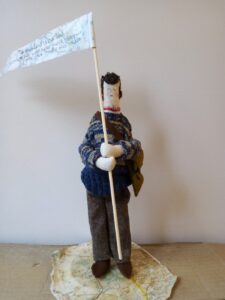
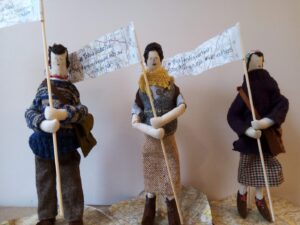
For the next couple of months I’ve got three dolls on display as part of the “Pitchfork” exhibition at The Workers Gallery in Ynyshir.   The exhibition is exploring the use of domestic objects as artefacts of resistance and defiance.  I confess that it took me a while to decide what my defiant dolls were going to protest about because there are so many possibilities in the UK at the moment, including it not being legal to protest.  In the end I settled on Kinder Scout, a name that most people in the walking/rambling/hiking world are familiar with.  Kinder Scout is a tor in the Derbyshire Peak District and on the 24th April 1932, it was the scene of a mass trespass across moorland that was owned by the very rich Duke of Devonshire.  He used it to shoot grouse for 12 days a year and fenced it off the rest of the time.  More than 400 workers from the factories and industrial heartlands of Manchester and Sheffield converged at the start of the walk and were met by estate workers of the Duke of Devonshire and a large contingent of the Derbyshire Constabulary.  Inevitably scuffles broke out and when the (alleged) five ringleaders were arrested and subsequently sentenced to prison, the whole episode should have been recorded as a win for the aristocracy.  But it wasn’t.   In the years since 1932 the Kinder Scout Mass Trespass has become a talisman of the unfairness of land ownership, inequality of wealth distribution and the class divide.  Every 24th April, up and down the country, walking groups and individuals recreate the Kinder Scout Mass Trespass not only as a symbolic gesture of resistance and defiance but also as a rallying cry for the expansion of access rights and protection of the environment.

Cat sitting and Defiance – a risky combination


Although I’m as Welsh as anyone born and brought up in Port Talbot can be, my family tree has roots and branches right across Europe.   The only thing which links my ancestors is that they all come from working class or peasant stock.  We have always been poor, honest, salt of the Earth kind of people.   I think it’s thanks to the varying traumatic experiences of my antecedents at the hands of the rich and/or powerful that I have a profound distaste for injustices however they manifest themselves.  In particular I get really, really annoyed at a social system that relies on – and is perpetuated by – the “haves” being entitled to more rights than the “have nots”.  One of the things I liked about the history of the Kinder Scout Mass Trespass is that although the people arrested were men, many of those who took part in the protest were women.  As one branch of my family tree lived in Manchester and may have wanted to walk on Kinder Scout, I decided to make dolls called Annie, Edith and Mabel and to stand them on maps of the Derbyshire Peak District. This is where it got a bit tricky because I had to finish the dolls whilst I was doing cat-sitting job at a very posh house in a very posh part of Wales.

Measuring Poshness

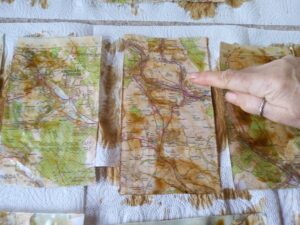
How posh is posh? Well, Crickhowell has only three charity shops (my home town has about 12) but at least one of them yielded an old OS map of Derbyshire.  Mind you, I still needed to laminate the paper.  Without my laminator – indeed, without many of the bits and bobs that a mixed media artist keeps in their studio – it came down to an afternoon of paper tearing, some fragrant and probably expensive coffee (found in the pantry), a pot of PVA glue (found in the garden shed) and a desperate hope that the very expensive kitchen worktops in the posh house would recover.


Annie

I had taken some prepared dolls to Crickhowell with me but as there is no mention in any press reports of the day about the Kinder Scout protestors being naked, clothes needed to be made.  I had a small sewing kit and a couple of scraps of fabric and felt.  That sorted out the boots and the skirts but unless the dolls were going to be topless as they launched their campaigns, they were going to need jumpers.  I intended Annie to be waving a flag raising awareness about the need to care for nature in general and pollinators in particular.  She thinks someone needs to make politicians understand that when the last bee has died, it won’t matter how much money you’ve got because there’ll be no artisan bread left to buy when there’s been no wheat harvest.  Is that a message that people will listen to if Annie is flouncing around, not wearing a sweater?  I don’t think so but I had no suitable material.

Hmmmm.  Think hard and look at the dark red socks I’m wearing.

Edith

Edith is demanding better public transport and traffic free routes – both causes close to my heart.  I love bus travel and am ancient enough to remember when there were conductors on the old Western Welsh buses.  The back seats were reserved for the chain smokers, those who liked the occasional cigarette clustered in the middle part of the bus and the non-smokers were in the front couple of rows.  In 1970s Bridgend, the service known as the “Flyer” – it missed out the loop around a local council estate and meant you could get from our village to town in 10 minutes instead of 25 – would speed into the bus station, swerve into a massive washing shed with giant water hoses, thick rotating brushes and industrial sized bubbles, and the driver shouting “CLOSE THE WINDOWS, KIDS!”  Who needed to go to a fun fair?  It was the highlight of our Saturday mornings.  We (as a country) should never have de-regulated public transport and Edith agreed with me, or she would have if she wasn’t topless as well.

Think harder and look at the blue Fair Isle socks ready to be worn tomorrow.

Mabel

I grew up in Port Talbot where the beach was sandwiched between the steelworks on one side and the BP petrochemical plant on the other so I know what it’s like to swim in polluted water.  But there’s a difference between splashing about in heavy chemicals and wallowing in raw sewage.  The solution is, of course, very simple.  The people who make the decision that it’s ok to put untreated excrement into our rivers and seas should be first in the water to prove its health giving properties to the rest of us.  I did think of putting Mabel in a bathing costume made of a pair of knickers to make her point but luckily I found some emergency fabric for a skirt.  That still left the lack of a top.  The night time temperatures in Crickhowell in late February are generally known as nobbling.  Especially in a house where Alexa only condescends to put the central heating when it suits her rather than my feet. 

Not surprisingly I looked hardest of all at the last pair of socks in my suitcase.

Last Thoughts

So there we are – if you live in South Wales and want to see my resistant and defiant efforts, the Pitchfork exhibition is on Fridays and Saturdays until the 8th July.  You will be able to find out about one of the seminal protest events of the 20th century, appreciate my doll making skills and – if that’s not enough excitement – you can get up close and personal with my socks.

Resistance is not futile

Hands up those of you who have managed (like me) to get to a ripe old age living with PDA without realising it is an actual condition rather than a natural tendency to be arsey.  PDA stands for Persistent Drive for Autonomy and in its extreme state it can cause crippling anxiety and lots of negative socialisation challenges.  I am not extreme so for me, PDA manifests itself as a resistance to being told what to do by pretty much anyone who hasn’t asked my permission first to tell me what to do.  You might see how this attitude could impact on my ability to win friends and influence people in a workplace like the NHS or in the various universities that I have graced with my presence over the years.  Actually I was best friends with PDA from the minute Tracy Jones (the school bully at Ynysawdre Comprehensive and nemesis of the 13 year old me) told me her favourite pop group was Slade and I had to – Hang on! I’m getting behind of myself.  Let’s go forward a bit…


After Protest Comes Resistance

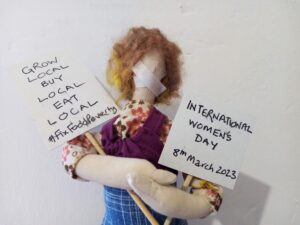
2022 was remarkable in that I took part in two excellent exhibitions with The Protest Dolls.  Some of them have just had another little outing to mark this year’s International Women’s Day but all of them are responsible for me being invited to submit 3 dolls to another exhibition at The Workers Gallery, the theme of which centres on objects of resistance and defiance rather than protest.  As is so often the case when an exhibition is mooted, I haven’t a clue where to start but luckily I am surrounded by people who respond when I send out a broadcast Watsapp text asking for their input.  On this occasion I explained the subject and that I would appreciate their replies.  It turns out that I know some seriously angry folk.   I mean, incandescent with rage level of angry.  Mostly about the intentional and possibly imminent destruction of the NHS by the present government but then there were also forays into inequality, injustice, misogyny, a deliberate policy to increase poverty and social division as well as the ill-treatment of people with disabilities before we scraped the bottom of the reality barrel with “and that awful television programme Dancing on Ice”.  Apart from the slip sliding celebrities, there seemed to be a central clustering around a disagreement with the sense of entitlement some individuals and industries feel, getting rich and abusing power at the expense of both public services and the people they purport to serve.  I gathered together all my research materials and waited for an idea to surface.

False Start

What about making an NHS doll that looked ancient and worn out by the effort of keeping going in the face of underfunding, gaslighting and the threat of privatisation?  I printed Nye Bevan’s immortal words on some cotton and then aged it in some coffee dye.


And then I thought this isn’t an object of resistance: it’s a statement of protest.  Which is why I went back to the drawing board and recalled the nightmare which was Tracy Jones.

It’s Noddy Holder Or Else

In Lainey Lancaster’s book “Nana Joy and The Sadness of the World”, objects take on meaning and meaningfulness.  I don’t clutter my life with sentimental stuff but there are some things I remember having because they were important symbols of a decision I took.  My school satchel was just such a thing.  In the days before rucksacks we all packed our books and sandwiches into leather satchels.  My sisters both had ugly dark brown things but mine was a beautiful tan colour.  And whereas theirs got both scuffed and scruffy, I used to polish mine with Cherry Blossom Tan shoe polish so that even two years into Comprehensive School, my satchel was still smart and shiny.   Sadly, this annoyed Tracy Jones.  One Friday afternoon she pushed me up against the cloakroom wall and demanded that I should carve the name of the lead singer of her favourite pop group on the front of my satchel.  Fair play, she even held up a blunt Swiss Army knife that I could borrow to do the deed but then as the end of school bell rang, she generously allowed me a reprieve.  By Monday, she said, my satchel would have to have to say Noddy Holder or else.

School photograph


It took me all weekend to work out a plan and then an hour scratching into the leather of my satchel with the point of a geometry compass on Sunday night but by Monday, thanks to my PDA, I was ready for Tracy.  She and her lieutenants cornered a group of us after lunch.  One by one, satchels were inspected for Noddy Holder’s name, and then she came to me.

“Who the f*ck is Colin Blunstone?” she demanded.

“Haven’t you heard of him?” I said incredulously.  “He’s higher in the charts than Slade at the moment.  He was on the Top 20 yesterday and Top of the Pops last week.”

“Course I’ve f*cking heard of him. (She clearly hadn’t.) He sings that song. ..”  Her lieutenants started to titter.

“I don’t believe in miracles,” I offered helpfully as she shoved me into the wall and stomped away.

Although I have ever since because thereafter Tracy Jones left me – and my satchel – alone.

An Object of Resistance

So I realised that in the same way as the Protest Dolls simply held their placards aloft, I could make a doll which was a carrier of an object of defiance to something or someone.  If you think about it, all forms of resistance come about because an individual has a drive of autonomy.  When we fall into the habit of acquiescence, we internalise anger rather become defiant.  The whole point of autonomy is that it allows you to develop strategies to do something about the situation you find yourself in.  Each of the dolls I’m making for this exhibition will hold and stand on some crafted symbol of resistance.  The event they represent proved to be anything but futile and it is one which still resonates with me partly because it relates to a personal interest and partly because if there’s one thing (actually there are a lot of things) I can’t stand in this world, it’s bullying.  The way in which some people think that they can impose their will on anyone else just because they want to is just wrong, plain and simple.  It’s the resistance to that wrongness that my Defiant Dolls are going to commemorate.  And look, one of them will be carrying a teeny weeny replica of my satchel as a gesture.  The map might give you a clue as to what the final subject will be but if you can’t guess, I’ll explain more in next month’s blog.

Incidentally

I still carry a satchel of sorts although these days they’re called Field Bags.  Mine now is made from a hi-tech waterproof fabric but it’s got enough space for my books and sandwiches as well as a pocket designed specifically, it seems from size and shape, for a bag of giant chocolate buttons.  I took it with me this week when I went to visit a nature reserve near Talgarth called Pwll y Wrach – The Witches’ Pool but there was no sign of Tracy Jones so my satchel still doesn’t say Noddy Holder.


New Year, Nearly New Plan

It’s that time of year when I give the website a good spring clean.  Truth be told, I actually started in November last year when I changed the domain name from marialalic.co.uk to marialalic.cymru.  Well, I say I changed it but I’m sure we all know that it wasn’t me because I am IT skills deficient.  What I did was send an email to Stuart at Tekeez (my website hosts) and said “Can I do this?” and “How much will it cost me?” to which he replied “Yes, you can” and “£20”. Bargain.  Especially if I start keeping the website up to date and paying attention to things like page views and bounce rates.  This is unlikely, however.  Over the years I’ve been told by lots of people who have been very sure that they know what’s best for me and my business model that the only reason to have a website is to attract paying customers to things or skills I have to sell.


Actually the only reason I have a website is so that I can keep track of what I’ve done and what I want to do.  This sort of filing system is important because half of my brain likes to think of itself as a serious, meaningful artist and the other half only wants to make the sort of homespun craft that Caroline Ingalls would have kept in her Little House on the Prairie.  Quite often the two halves end up jostling for supremacy and the winner takes all of my time, effort and money for a few weeks or months.   Until recently the website was a bit like the miscellaneous drawer that everyone has at home: a place where things are lost when they are needed and found when they are not.  But not anymore.  Behind the scenes, there is a digital tidy up in progress.  I have updated the Gallery and the Timeline and I have rewritten the page on Doll-Making.

Perhaps next month I will explain a bit more about this year’s serious, meaningful art project but for the moment, Caroline Ingalls is in the ascendant so let me introduce you to Scarecrow Cottage.   When I first became self-employed, selling at craft markets made up a lot of my earnings.  I didn’t have a car so everything would be rammed into a suitcase on wheels and I’d trundle from house to bus stop then bus stop to wherever the event was.  On a good day I’d bring home fewer goods and more money than I started out with but there were occasions when I was just happy to earn enough to be able to pay for the table.  I stopped doing craft markets for a few years while I was concentrating on my MA, the Unlost Places project and a growing mentoring practice but lately, I’ve been thinking I want to get back out there.  And let’s face it – could there be a better time to get people to interact with teddy bears than during a cost of living crisis, a period of social unrest and at the beginning of an economic recession?  All of which brings us to the three different facets of Scarecrow Cottage (none of them require you to visit an online shop).

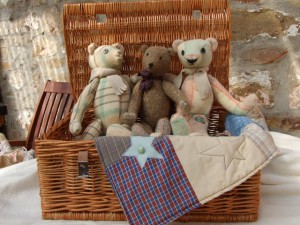
Hand made teddies

Scarecrow Cottage Hospital

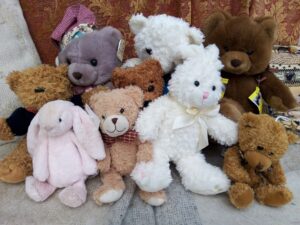
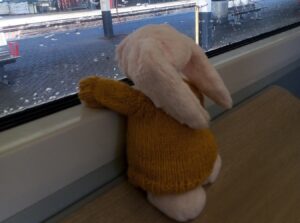
What first started as repairing a very distressed Raggedy Andy for a friend has now become a bit of a phenomenon on my social media platform.  Take Smudge, for example.  Smudge (the little pink rabbit, front left) was part of a large group of soft toys that were to be gifted to a local charity so that they could distribute them as Christmas presents.

Sadly Smudge had a stain that wasn’t removed in spite of repeated laundering.  Smudge developed a cult following thanks to posts on social media.  He starred in his own online Advent calendar; people offered to knit him jumpers; strangers wanted to adopt him; at the New Year’s Eve parkrun in Porthcawl a bloke sidled up to me and said “How’s Smudge?”  as if he really cared about the answer.   The point of this ramble is that most people would prefer to see soft toys repaired and re-homed than sent to make yet another layer of landfill.

So my plan is to take Scarecrow Cottage Hospital on tour to libraries, museums, vintage fairs, craft markets or anywhere else where people can watch as a distressed or injured teddy bear, cloth doll or little pink rabbit is given a second chance of life.  Programmes like The Repair Shop and Money For Nothing have shown that there is an appetite for mending instead of throwing away and it’s not just because it makes more economic sense.

Scarecrow Cottage Crafts

In my dreams I’m going to have a log cabin in the bottom of my garden and I’m going to fill it with vintage lace, embroidered tablecloths, patchwork quilts, teddy bears, cloth dolls and cat-related ephemera.   And a doll’s house.  And the bits and bobs to go in a doll’s house.  Until that day comes I’m going to amuse the craft side of my brain by sourcing and making these things.  And if I turn up at a craft market and put all of my treasures on the table, it won’t bother me at all if people want to look and admire rather than spend money (though if that’s what they want to do I won’t stop them).  The lesson that I’ve learnt from my early days of selling stuff is that I shouldn’t try to get inside the heads of potential customers.  I need to make the things that will look at home in my log cabin.  If I meet kindred spirits (aesthetically speaking), that would be lovely but equally, if I end up bringing everything home, my log cabin is better furnished.  Definitely a win-win situation.

 Scarecrow Cottage Memories

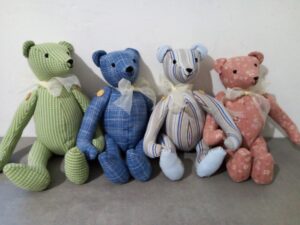
For as long as I’ve been self-employed I’ve refused to do commission work.  This has mostly been because I’ve never felt confident about being able to translate a customer’s imagination into a piece of artwork.  It had never occurred to me to take craft commissions but last autumn I gave in to a request and made some memory bears from my own pattern.  Then I made a memory doll – again from my own pattern.  So while the textile artist me is still going to refuse to take commissions, I think Scarecrow Cottage Memories – the teddy bears and dolls made from fabrics that have personal history to a someone I perhaps don’t know yet – is a great way to use heritage craft skills and keep stories alive.

There’s been some discussion recently about whether people are losing the ability to absorb more than a few lines of writing.  If you’re down here and you’ve read the blog as well as looked at the pictures, you’re bucking the trend of humanity so congratulations on being someone special – the world needs you!