Last night BBC4 showed a complete rerun of the 1974 Eurovision Song Contest and I wallowed in nostalgia. Weirdly the 1970s seem both like yesterday and like a really long time ago: yesterday because I recalled the songs so clearly but a long time ago because the angst of teenage years has faded and I can view most of the events that made me the person I am through a distinctly rosy hue. I studied Economics and British Constitution at A level with the aim of doing a related degree. The story of how that didn’t go as planned is for another day but for the moment let’s just accept that I have witnessed the Westminster shenanigans of the past few years with the objectivity of someone planning her next essay. In the years since I didn’t go to Swansea University to study for a BA in Economic & Social Studies and instead ended up doing a B.Ed in Home Economics at Cardiff, I have come to think that the future for most of us – ie, the ones who don’t have gazillions of pounds, euros or dollars in off-shore banks – lies in being budget conscious consumers who buy smart, not more. All of which brings us to doughnuts. This is probably a huge relief to those of you who are more interested in cakes than the production and distribution of wealth.

Cardiff 1976 – 1979
There were no lectures on Wednesday afternoons so my pals and I used to catch the number 25 bus from Llandaff to Cardiff city centre. We’d get off at the castle and work our way up Queen Street. The first shop was Marments with its immense communal changing room and no restriction on how many clothes you could take in with you to try on. There didn’t seem to be much shoplifting in those days but I know for a fact that Marments had been the victim of some criminal activity. Roll back a couple of years to when Mr Williams had arranged a trip for his British Constitution A level students to see judicial processes in action. Our class sat in the public gallery of Cardiff Crown Court to witness the case of Regina vs some chap who’d been caught by the rozzers as he climbed down Marments fire escape with a load of fake fur jackets in his arms. In his defence he said that he’d gone up onto the roof to get a better appreciation of Cardiff’s night sky, had found the jackets in a pile near a broken skylight and was on his way to hand them in at Cathays Police Station. We had to leave before the verdict but I often wonder if the jury believed him.
Next stop for us was Laura Ashley with its iconic desire to make us all look as if we’d walked off the set of Oklahoma. After I was ejected from the Food & Nutrition course at college for falling asleep in a 2 hour lesson about the mechanics of slicing an onion and forced into studying Textile Art instead, I found that my new lecturers expected students to dress with a little more creativity than the white overalls which were de rigueur in the kitchens. I embraced this philosophy – mostly because I was still traumatised by my mother once deciding that Annie (9) and I (11) should wear matching clothes. OK, it only happened on a single occasion but that was enough. I have always had the body shape of a not quite fully inflated Michelin tyre man and in her youth Annie was more like a member of Stickman’s family, all spindly legs and twiggy arms, so putting us both in dark brown trousers and cream jumpers was never going to work. On an outing to town a woman in Barclays Bank looked us up and down, said to Mum “twins?” and then without waiting for an answer jabbed a finger in my direction and demanded “have you been eating your sister’s food?”
So is it surprising that as an adult I found calf length skirts showing ruffles of petticoats, Fair Isle socks and ankle boots to be cathartic? The Laura Ashley look in those days was easily copied by cash strapped students who didn’t trust their mothers to buy clothes for them.
Our final destination was British Home Stores where there was a food hall selling doughnuts dusted in vanilla fragranced icing sugar that floated in clouds as the shop assistant picked them up with tongs to put in paper bags. Also if you got to BHS at about 4.15pm doughnuts were reduced to half price and as tea in the college refectory wasn’t until 6.30pm on Wednesdays, this meant that you could eat one walking back to the bus stop, one on the bus and have one to eat in the common room at 9pm.
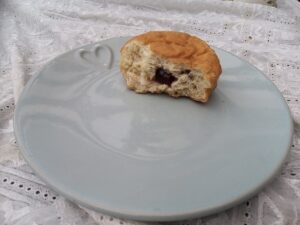
When Kate Raworth published the theory of Doughnut Economics as a model for sustainable development, it was not met with universal love and admiration by Capitalists but it made total sense to folk who worry about the future we are leaving for the next generation. The hole in the doughnut represents people who don’t have access to fundamentals like enough food, water, education etc. while the outside crust is the finite nature of a healthy environment; the cakey bit is humanity being part of a fair and just economy. I think about the people with the gazillions in the off-shore banks that they’ve made at the expense of others and/or the planet and I think about me spending a Sunday evening being very happy because I still remember the lyrics to “I see a star” which wasn’t even the winning song in 1974. Then I think of how if Kate had come up with her theory fifty years ago instead of in 2012, I could have written a cracking essay, passed the A level I failed and gone to Swansea University. But I’d never have become a Textile Artist, never done a degree in Creative Writing and never got in the habit of writing blogs. Mind you if I hadn’t written this particular blog I wouldn’t have had to buy lots of doughnuts to illustrate it and I wouldn’t now look like a fully inflated Michelin tyre man because I didn’t want to waste them.