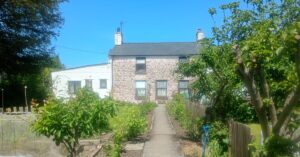
The oldest part of Scarecrow Cottage was built about 250 years ago. The owner before us (Lucy) once came across a brass plate from a travelling trunk in the garden and formed the theory that in its early life, Scarecrow Cottage was a coaching stop. Quite why coaches would have driving along what is now the A4061 but back then was a farm track going nowhere didn’t matter because when her husband (George) dug up an ancient pistol, it was taken by both of them as absolute proof that travellers in this part of South Wales needed protection from brigands and highwaymen. George subsequently reburied the pistol where he had found it so potentially I might uncover it one day when I am planting potatoes.
In 1861, Richard and Sarah Roberts added a two storey extension to Scarecrow Cottage, with a kitchen downstairs and a bedroom above. The original curving, stone steps which had been outside the house were enclosed in the cwtch dan star – a cubby hole under the new wooden staircase. Over the next sixty or seventy years and under the stewardship of different owners, Scarecrow Cottage continued as a productive croft with fruit trees, vegetable plots, a stable and a pigsty. Water came from a well and the privvy was a tin shed in the front yard where chickens roamed beneath a spreading horse chestnut tree.
Progress arrived in the late 1940s: the village’s jobbing builder built a lean-to for an indoor bathroom and also installed electricity (although the electrician who rewired the house for us a few years ago called the builder a psycho and his work a death trap). In the next few decades the garden fell out of use, outbuildings were taken down and no maintenance was done to the house. By the time Lucy and George arrived in 1969 Scarecrow Cottage was in a very poor state with damp walls, a leaking roof and mice living in most of the downstairs rooms. The garden was overgrown with nettles and brambles everywhere.
When Annie and I took on Scarecrow Cottage in the mid 1990s the damp was gone, the leaking roof had been replaced and the mice evicted. Sadly many of the original features had been lost or covered up. Lucy and George – like so many people of their generation – had ‘seventified’ their home. The garden, having been returned to vegetable growing in the 70s, was lawned by the 1980s and of the once thriving boundary hedgerow, only two trees – an English Yew and a Sycamore – remained.
At first we made changes discreetly and slowly, not wanting to upset George who used to say things like “but Lucy loved the way that looked” or “Lucy asked me to make it like that” whenever we floated an idea past him. Now, with George no longer around, Annie and I don’t need to be discreet but the changes are still slow because with an old house, every change you make is likely to expose a problem that you were quite happily living with when it was unknown but has to be dealt with quickly once you find out about it.
We’re at the stage where we are considering whether our future lies at Scarecrow Cottage or if it’s time to move to something smaller, easier to look after and less likely to bankrupt us. Common sense, of course, says the answer is yes: we should set up an alert on Right Move, start scouring Estate Agents’ windows and maybe even put in a call to Kirstie and Phil. But – and it is, at the moment, an overwhelmingly big ‘but’ – as Annie says, could we find another house that feels like it hugs us every time we walk through the door?