All posts by Maria

New Year, Nearly New Plan

It’s that time of year when I give the website a good spring clean.  Truth be told, I actually started in November last year when I changed the domain name from marialalic.co.uk to marialalic.cymru.  Well, I say I changed it but I’m sure we all know that it wasn’t me because I am IT skills deficient.  What I did was send an email to Stuart at Tekeez (my website hosts) and said “Can I do this?” and “How much will it cost me?” to which he replied “Yes, you can” and “£20”. Bargain.  Especially if I start keeping the website up to date and paying attention to things like page views and bounce rates.  This is unlikely, however.  Over the years I’ve been told by lots of people who have been very sure that they know what’s best for me and my business model that the only reason to have a website is to attract paying customers to things or skills I have to sell.
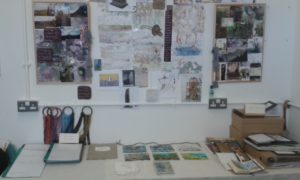
 

Actually the only reason I have a website is so that I can keep track of what I’ve done and what I want to do.  This sort of filing system is important because half of my brain likes to think of itself as a serious, meaningful artist and the other half only wants to make the sort of homespun craft that Caroline Ingalls would have kept in her Little House on the Prairie.  Quite often the two halves end up jostling for supremacy and the winner takes all of my time, effort and money for a few weeks or months.   Until recently the website was a bit like the miscellaneous drawer that everyone has at home: a place where things are lost when they are needed and found when they are not.  But not anymore.  Behind the scenes, there is a digital tidy up in progress.  I have updated the Gallery and the Timeline and I have rewritten the page on Doll-Making.
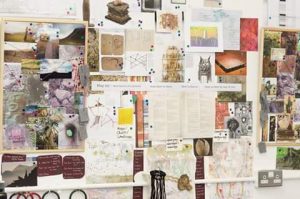
Perhaps next month I will explain a bit more about this year’s serious, meaningful art project but for the moment, Caroline Ingalls is in the ascendant so let me introduce you to Scarecrow Cottage.   When I first became self-employed, selling at craft markets made up a lot of my earnings.  I didn’t have a car so everything would be rammed into a suitcase on wheels and I’d trundle from house to bus stop then bus stop to wherever the event was.  On a good day I’d bring home fewer goods and more money than I started out with but there were occasions when I was just happy to earn enough to be able to pay for the table.  I stopped doing craft markets for a few years while I was concentrating on my MA, the Unlost Places project and a growing mentoring practice but lately, I’ve been thinking I want to get back out there.  And let’s face it – could there be a better time to get people to interact with teddy bears than during a cost of living crisis, a period of social unrest and at the beginning of an economic recession?  All of which brings us to the three different facets of Scarecrow Cottage (none of them require you to visit an online shop).
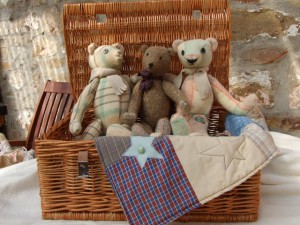
Hand made teddies

Scarecrow Cottage Hospital

What first started as repairing a very distressed Raggedy Andy for a friend has now become a bit of a phenomenon on my social media platform.  Take Smudge, for example.  Smudge (the little pink rabbit, front left) was part of a large group of soft toys that were to be gifted to a local charity so that they could distribute them as Christmas presents.
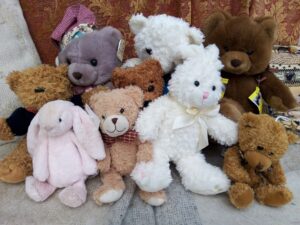
Sadly Smudge had a stain that wasn’t removed in spite of repeated laundering.  Smudge developed a cult following thanks to posts on social media.  He starred in his own online Advent calendar; people offered to knit him jumpers; strangers wanted to adopt him; at the New Year’s Eve parkrun in Porthcawl a bloke sidled up to me and said “How’s Smudge?”  as if he really cared about the answer.   The point of this ramble is that most people would prefer to see soft toys repaired and re-homed than sent to make yet another layer of landfill.
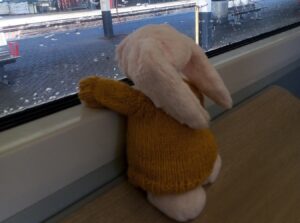
So my plan is to take Scarecrow Cottage Hospital on tour to libraries, museums, vintage fairs, craft markets or anywhere else where people can watch as a distressed or injured teddy bear, cloth doll or little pink rabbit is given a second chance of life.  Programmes like The Repair Shop and Money For Nothing have shown that there is an appetite for mending instead of throwing away and it’s not just because it makes more economic sense.

Scarecrow Cottage Crafts

In my dreams I’m going to have a log cabin in the bottom of my garden and I’m going to fill it with vintage lace, embroidered tablecloths, patchwork quilts, teddy bears, cloth dolls and cat-related ephemera.   And a doll’s house.  And the bits and bobs to go in a doll’s house.  Until that day comes I’m going to amuse the craft side of my brain by sourcing and making these things.  And if I turn up at a craft market and put all of my treasures on the table, it won’t bother me at all if people want to look and admire rather than spend money (though if that’s what they want to do I won’t stop them).  The lesson that I’ve learnt from my early days of selling stuff is that I shouldn’t try to get inside the heads of potential customers.  I need to make the things that will look at home in my log cabin.  If I meet kindred spirits (aesthetically speaking), that would be lovely but equally, if I end up bringing everything home, my log cabin is better furnished.  Definitely a win-win situation.

 Scarecrow Cottage Memories

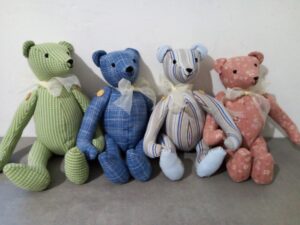
For as long as I’ve been self-employed I’ve refused to do commission work.  This has mostly been because I’ve never felt confident about being able to translate a customer’s imagination into a piece of artwork.  It had never occurred to me to take craft commissions but last autumn I gave in to a request and made some memory bears from my own pattern.  Then I made a memory doll – again from my own pattern.  So while the textile artist me is still going to refuse to take commissions, I think Scarecrow Cottage Memories – the teddy bears and dolls made from fabrics that have personal history to a someone I perhaps don’t know yet – is a great way to use heritage craft skills and keep stories alive.
There’s been some discussion recently about whether people are losing the ability to absorb more than a few lines of writing.  If you’re down here and you’ve read the blog as well as looked at the pictures, you’re bucking the trend of humanity so congratulations on being someone special – the world needs you!

Ripples and Fairies

I don’t want to minimise the grim reality faced by so many people in today’s world but there’s something that we can all do to contradict the belief systems of billionaires, corrupt politicians and megalomaniacs and that thing is to spread a ripple of kindness, humour and goodwill.   Hopefully some of these better traits of humanity will rub off on them because as Robert F Kennedy said:

Each time a man stands up for an ideal, or acts to improve the lot of others, or strikes out against injustice, he sends forth a tiny ripple of hope, and crossing each other from a million different centers(sic) of energy and daring those ripples build a current which can sweep down the mightiest walls of oppression and resistance.

The History of Fat Fairies – for the more MATURE Christmas tree

December 2007.  It’s my first ever craft show and my first ever outing with the over-stuffed cloth dolls that I am hoping to sell.  The show isn’t a success but the fat fairies are.  Indeed they prove so popular that I’ll be making at least 20 for Christmas events every year until 2022 and I’ll usually start each January with none left.

There’s no denying that some craft shows can be dire experiences for sellers.  The one in December 2007 was held backstage in a council owned theatre.  Dirty ripped black curtains draped down dusty walls and the organiser had issued an edict that Christmas decorations were not to be pinned to them in order to avoid damage – whether she meant damage to the curtains or to the decorations wasn’t clear.  Outside rain poured incessantly for the entire week of the market.  Inside the several holes in the roof made sure we all knew about the weather as water splattered on the bare floorboards.   Add to this that no-one had seen fit to advertise the event in the local press or the village or even put posters on the front door of the theatre building with arrows to direct people from the box office through the library, down the corridor, turn left at the toilets, past the café and into the auditorium before ascending some wooden steps and pulling back the safety curtains.  However a few of my fat fairies sold to other stallholders and there was enough positive feedback to ensure they’ve graced the world stage ever since.

Fat Fairies are for everyone

November 2011.  I have a stand at the Royal Welsh Winter Fair and one whole wall is covered by fat fairies.  The show chaplain -–a chubby and very jolly Anglican priest – arrives with an unusual request.  Would I, he wondered, take his photograph standing next to the big poster which said in large red letters “Fat Fairy – for the more MATURE Christmas tree”?  And furthermore, would I agree to him having the photograph printed on cards he could send to his congregation.  I say yes, of course.  A few hours later and I notice a man inspecting all of the fat fairies with forensic precision.  Eventually he settles on a buxom wench with bright yellow hair and a red velvet dress.  As he pays he tells me it’s a present for the woman he wants to marry but before he asks the question, he needs to know what sort of sense of humour she’s got.  If she takes the doll as a personal affront, she’s not the one for him; if she laughs, she is.


In all of the years I’ve been selling the fat fairies, this was the only time they have attracted the attention of men.  Women get the joke on the strap line and often buy the dolls either to celebrate their own size or to send to friends who will appreciate the sentiment.

But not for much longer

Since 2007 about 300 of them have found their way across the globe but guess what?  Their time is coming to an end.  I might make more but for the first time in 15 years, I’m thinking I might not.  As I’m not doing any craft fairs this Christmas, I have put this year’s tranche of fat fairies on my Etsy shop here .  I have to confess I am surprised that no-one has replicated the pattern or the motto.  In case you want to, here’s the pattern .

If you can sew, you don’t need instructions.  If you can’t sew, you’ll need to learn before you can make one.  Meanwhile I’ll be finding other ways to make ripples.


Does anyone know Michael or Tom?

What with the dry, sunny weather making for a full and early harvest, us hosting an open garden for the RNLI and me spending a lot of time wandering about Pembrokeshire doing research, it’s been a busy summer at Scarecrow Cottage.  The autumn usually brings a chance for us to slow down but this year is a bit different.  Back in March we began to raise money to help people who are homeless and living on the streets.  At the beginning of September, thanks to cash made in exchange for fresh, home-grown figs, apples and runner beans there was £30 in the savings tin.  Annie-Dora was put in charge of further fundraising and selecting an appropriate charity.  The campaign called Crisis at Christmas struck a note but finding a way to generate income when much of the country is in economic turmoil and the cost of putting food on the table or switching the heating on is going to be higher up the priority list than sponsoring a walk required Annie-Dora to have a lightbulb idea.  Which is when she came up with the idea of an Autumn Yard Sale.  Usefully, I have grown a surfeit of large, knobbly pumpkins which can be sold as such an event.

Annie-Dora felt we needed more so she watsapp’d all of her buddies and asked for donations of “stuff”.  Within days her study looked like a bomb had dropped.

Anything which she thought she could sell for more than £5 was posted to an on-line market and as a result the savings tin now has £80 in it.  In her own inimitable, ex-nurse way of looking at life, Annie-Dora equates this to being 2 people, an arm and a leg having a room and board over Christmas so we are on a push to bring the rest of the 3rd body indoors.  Not everything has been marked for sale though.  The animated goat that produces a squeaky Julie Andrews’ version of The Lonely Goatherd is apparently something she can’t live without so paid £5 for it herself.

On the other hand the wall lizards were snapped up almost as soon as they were posted, with a queue of eager buyers waiting in hope to be chosen as their new owner.

From someone who a year ago was a technophobe, Annie-Dora has embraced the digital marketplace and spends her time with a tablet in one hand and phone in the other, screaming excitably when she hears the unique ping that indicates commercial opportunity.  And my role in all of this?  You might have thought that as a mentor who supports people starting their own business I would be called on to offer sage advice; as an artist and writer maybe I should have been put in charge of publicity; and as an ex Home Economics teacher, perhaps my talents could be used on the cake or craft stall.  No.  Apparently the skill I have which outweighs all of the above is that I use Twitter.  So it turns out do Michael Sheen and Sir Tom Jones – heroes to Annie-Dora – and she is determined to have one or both of them to either turn up on the day of the Yard Sale or at least to wish her well on social media.  My reply that these outcomes are unlikely is batted away as defeatist and pessimistic.  I have explained that my connections with these two Welsh icons are limited. Yes, I was born and brought up in Port Talbot, just like Michael and once posted a photograph of Aberavon Beach on Twitter which he liked but these are not grounds for asking a world famous actor to arrive on a Sunday morning in the hope of buying a light up reindeer. As for Sir Tom, the link is even more tenuous: back in the 1990s when my late Mum was very ill, she insisted that I drive her around the Vale of Glamorgan looking for a house she’d heard he was staying at.  I did a 3 point turn in his – if it was his – drive but we came away without seeing him.  So the only idea I’ve come up with to meet Annie-Dora’s demand is to write a blog about our Yard Sale, put the link on Twitter and tag it to Michael and Tom.

If anyone has anything better to suggest, I’m listening. And if you know either Michael or Tom, do me a favour and ask them to like the post.

The Trouble With Pigeons

Last week, in between working in one place and attending a meeting in another, I found myself with a few hours to kill in Aberystwyth.   Allow me to provide a brief description of Aber for those who’ve never been there: the town itself has more than the usual quota and variety of independent shops in its criss-crossing streets.  Most of these slope gently uphill, tantalising you with glimpses of a sun-sparkled sea and then distracting you with a potential retail experience of crystals or ceramic puffins or batik clothing, all of which you had managed without having in your life until now.   A quirky one-way traffic system torments the problem-solving skills of tourists but is probably beloved by the office-bound town planner who designed it and fair to say, it seems to have been embraced by locals who have a je ne sais quoi attitude to that old chestnut of who gives way to whom at junctions.   Pedestrians find it easier than drivers to get to the sea front where a pastel coloured ribbon of tall Victorian buildings (mostly flats, B&Bs and Guest Houses) gaze languidly across the wide expanse of Cardigan Bay.  In winter, ferocious storms sweep in from the Atlantic and those same buildings – as well as the road, the pier and the regularly repaired bandstand-  are stranded victims to a battering of debris thrown up by mountainous seas.  The mile long promenade borders North Beach, the castle ruins and South Beach, running from Constitution Hill at one end to the harbour at the other.  On the day I was there the weather was sunny with a warm breeze.  Knowing that more people frequent North Beach than South Beach, I headed for the latter and convinced myself that my day – which I supposed would be trouble-free – should start with a freshly made almond croissant and coffee.

Even though the photographs in this blog are of Aberystwyth, I’m going to digress (as usual) partly because that’s my modus operandi but also because some things need to be mentioned.  This is not going to be a political post even though we have come to a point in history that I and many others have spent the last few years hoping and praying for.  As I write this blog there has been a momentous event in Downing Street.   On Thursday, 7th July 2022, an expression of graceless egomania showed how, in the end, the real nature of all living things can become obvious to a watching world: dignity and self-respect are casualties of a mind led by self-indulgence and delusion; pretence falls away as each individual is finally seen for what they are and what they do.  At some point a film was posted on social media of Larry the Cat (Cabinet Office Chief Mouser) hurtling across the road from Number 10 and launching a violent assault on a perambulating pigeon.  Spoiler alert: the pigeon escaped in a flutter of feathers, Larry returned to the shiny black door pretending it had never happened or, if it had happened, it had been someone else’s fault .  Like so many others  in Westminster, his demeanour declared that he would remain unrepentant for as long as a television camera was pointing in his direction.

Which brings me to the trouble with pigeons, or at least the pigeons intent on forcing themselves into my little bit of the universe.  We have been keeping poultry for over 20 years.  There has been a natural population decline recently so the only current residents are Lola and Spock the ducks, and Dee the chicken.  Twice a day they are presented with a shallow dish of corn which is left out for about a quarter of an hour and then retrieved to be placed indoors.  In that short window of time however, wild birds line up to take advantage of what is basically an eat-all-you-want buffet.  At least they do until PP (the initials stands for Professional Pigeon) turns up.  PP is immense.  Think of a cross between a sumo wrestler and a grey feathered extra from Jurassic Park and you’re getting close.  The ground shakes when he lands.  He has single-wingedly cleared the chicken run of rats.  Crows, jackdaws and magpies – none known for their unwillingness to back away from free food  – do emergency take offs and watch from a safe distance as PP attacks the corn dish as if he’s part Tyrannosaurus Rex, part Dyson.  PP is here because Annie, known to our neighbours as “chicken woman”, has an uncanny knack of finding injured or exhausted racing pigeons and nursing them back to recovery by putting them in the garden shed and providing corn and water until they are fit enough to continue their journey.  PP, knowing a cushy life when he saw it, refused to be discharged.

Sometimes, of course, the patient never regains health.  That’s what happened with Juan.  Juan not only flew off course but did so with a fairly spectacular head first impact into a tree trunk.  When Annie rescued Juan he was barely conscious but she made him comfortable on a little bed of straw, dribbled water into his beak, took the reference number off his foot ring and made contact with the owner, a Spanish man living in Huddersfield.  Annie had been a nurse for all of her working life and made her fair share of bad news phone calls to relatives but she’d never had to deal with someone as distraught as Carlos.  Eventually it was agreed that Juan be taken to the local vet and Carlos said he would pay anything – any amount at all – to get Juan the very best treatment they could provide.  (Call me cynical, and just as an aside borne out of years of cat and dog keeping experience, but that’s a very rash attitude to take to a vet.)  Anyway Juan was duly delivered to the local animal hospital but by the next day, it was decided that he had suffered brain damage and would never fly again, let alone race.  Even as Carlos was arranging an animal ambulance to bring Juan home to live out his days watching the comings and goings of his contemporaries from a little box in a Huddersfield pigeon loft, the inevitable happened.  Juan was no more.  Carlos was inconsolable.  Annie knew this because the vet had rung her to ask what to do with the body and Annie had made another difficult phone call.  Carlos paid for cremation, Juan’s ashes were scattered in our field and there is now, and forever, a little part of Yorkshire in South Wales.

Hang on, you’re thinking.  This woman usually writes a blog about textile art and this month so far we’ve had a political cat attacking a pigeon, a sumo-wrestling corn-addict pigeon and a traumatic brain injured pigeon.  Well, allow me to introduce you to the fourth member of this group: the photobombing pigeon.  Back in Aberystwyth I had settled on South Beach to do a bit of field sketching.  The first stage of using pebbles as relief went well.  The watercolour paints I used gave exactly the effect that I was looking for to capture the atmosphere of what it was like to be sitting above the strandline of Cardigan Bay as relentless waves washed in and out, rattling the shingle and the shells.  I positioned the sketchbook and paints for their obligatory snap shot.  Just as I pressed the shutter button, this happened.

Anyway here’s the picture without pigeon.

And here’s the stitched sample it led to.  So if you ever have a couple of hours in  Aberystwyth (or Faberystwyth as it’s affectionately called by locals) and you’re not sure how to spend the time, just look for the photobombing pigeon. He’ll show you the best bit of beach to sit on, the best view to sketch and the best place to get a freshly made almond croissant.


Blame it on the Clangers

Proverbs are great for providing brief responses when you have to explain yourself or try to avoid the blame game at short notice.  I’ve always thought that pride comes before a fall and calm comes before a storm have a pragmatic, I-told-you-so sort of wisdom to them. Now I’ve added another one to the collection: knitting Clangers comes before index finger tendonitis.

Pride

My default setting is to be contrary so when there was a surge of enthusiasm for decorating street furniture with regal yarnbombing to mark the Platinum Jubilee, I knew that I wasn’t going to just resist the trend – I was going to buck it.  If I were the sort of person to tie knitted things in public places which – as it’s technically illegal (littering) – obviously, I would never do, then I would need to make something distinctly un-royal to attach to some hypothetical traffic bollards on a hypothetical main road near my hypothetical home.  And so it came to pass that I obtained a book of Clanger knitting patterns and my worst nightmare was about to unfold.

To be fair I couldn’t just blame it on the Clangers: they didn’t cause the tendon in my right index finger to start screeching with pain every time it adopted the knitting position.  No, it was the double whammy of knitting Clanger bodies on consecutive days then crocheting Clanger planets (one for each hypothetical bollard) in the evenings that really did the damage.


Fall

At the start of May, with my best and most important finger swollen and inflamed, I realised that any hope of a Clanger takeover of concrete posts was doomed.  One afternoon I consulted Dr Google, applied the advised ice, rubbed in the advertised anti-inflammatory gel and rested as instructed.  The morning after I was disappointed to find that none of these had cured my digital ills and as I had three dolls to make in as many days for the exhibition of Heritage Crafts at The Turner Gallery in Penarth, my finger was told to take one (or three) for the team.  The five Clanger planets, one completed Clanger and a pile of pink woolly body parts were consigned to the UFO basket in my workroom – a harsh but necessary decision.

Calm

Mid May and all of the Protest Dolls were safely installed in Penarth for a month so it was time for me to turn my attention to my Unlost Places project.  Unlost Places involves me visiting places in Wales which are atmospheric, mysterious and other-worldly, then making arty stuff to illustrate what it’s like to be there.   As there isn’t a map upon which places are marked as “atmospheric”, “mysterious” or “other-worldly”, I think it would be a good idea to write a book about them (with photographs of my arty stuff for anyone who doesn’t want to read the boring bits).


Caldy Island

People who love Tenby say that everyone should go to Caldy Island.  I don’t particularly love Tenby because I’m traumatised by the cheap hotel room I stayed in once.  It turned out to be cheap because it was also the main fire escape for guests staying on the same floor, all of whom evacuated the building when there was a (false) alarm at 2 o’clock in the morning by forcing open my bedroom door.  They traipsed past a stunned and terrified wide-eyed me who was clutching trembling blankets to my chin – like that was any sort of defence against what I presumed at the time was a zombie invasion.  Anyway, my point is that as I don’t love Tenby, I should have heeded my instinct about Caldy, which was to not bother paying the £13 for a ferry ride and to have a nice ice cream and wander around town instead.  But as I said earlier, I am nothing if not contrary so I went.  It takes about 30 minutes to sail to the island and then weirdly, it’s like you’ve arrived on a film set that’s a cross between The Stepford Wives and The Prisoner.  There’s not a single blade of grass out of place on the manicured lawns and it’s chocolate box pretty,  with quaint little houses overlooked by an Italianesque abbey perched high on a wooded hillside.

I wasn’t looking for pretty, quaint or Italianesque so whilst everyone else who had been on the boat stayed in the village, I headed along a trail through the trees which was a bit more atmospheric but not deeply so.  Still I managed to create some Unlost Places indigenous art and took a moody photograph before getting on the first ferry back to Tenby.  Unsurprisingly Caldy Island is not going to make it into my book of creative maps.

Amroth

I’ll tell you what I like about Amroth.  It’s a dead end.  The road skirts along the beach making a lovely flat promenade for walking and then it stops, not even attempting to turn itself into a little lane that could lead over the headland to the hamlet of Marros.  There’s archaelogical evidence that people have been calling Amroth home for thousands of years.  Some locals say that the name Amroth comes from a little stream that bubbles into the sea here; others that it relates to a “rath” (Iron Age earthwork) high on the ridge.  Amroth Castle is now privately owned and a rebuilt, re-imagined version of its 12th Century origins.  St Elidyr’s Church, a mile up a vertiginous track that runs from the seashore to the isolated hilltop farms, is also medieval and probably built on the site of an early Christian llan.  And just as you’re thinking that all Amroth has to offer is a few cafes and shops, a bit of manageable Welsh history and a comforting air of nothing-to-do-ness, it turns out that there’s a sizeable chunk of industrial heritage too because of the anthracite mining that used to go on in the area.  The exciting thing however from my point of view is that Amroth was/is also on a pilgrim route.

Follow the Wales Coast Path east and you pass through Marros to Pendine then on to Laugharne and Llansteffan.  Take the ferry across the estuary to Glan y Ferri and before long you pass St Ishmael’s and join the pilgrim road to Kidwelly.  Or if you climb the steps at the western end of the beach, the path leads you to Wiseman’s Bridge where there’s a woodland trail towards Kilgetty, Templeton and all spiritual points leading to St David’s.   Apparently the effort of two pilgrimages to St David’s is equivalent to one to Rome but if for you, step climbing is beyond the pale – fear not!   Amroth has an alternative.  At low tide the sea retreats far enough for all but the least intrepid person to walk across the sands to Wiseman’s Bridge and even carry on to Saundersfoot, a mile away.  When the tide comes back in, there’s a traffic free path along a disused railway line which gives a safer journey.  It skirts the coast and plunges in and out of dimly lit tunnels either side of the lovely Coppet Hall beach.

When I write Amroth up to go in the book, I’ll do more research; I’ll put in more facts; I’ll take photographs of my arty stuff as illustrations.  Which brings us back to my Clanger caused index finger tendonitis.  How does a textile artist make textile art and a doll maker make dolls when she can’t stitch?  Well, it turns out to be not that difficult if you have access to bondaweb

or if you learnt your doll making in the 1970s.  I do confess to sewing the eyes onto the Amroth Pilgrim Doll but otherwise no needles were threaded in the cause of this blog post.

Storm

The invalid finger has another five weeks of sick leave to go before it is unleashed, hopefully recovered, on an unsuspecting world.  Given that there are five planets crocheted but only three Clangers knitted, you might think that I have a decision to make.  You might think that I should risk knitting another two Clangers.  Or you might consider that I should buy some green felt and sew a Soup Dragon and some silver fabric to make an Iron Chicken.   Well, it turns out that none of these apply because last week during one of those rainstorms which we get all too often these days, a woman who was texting instead of concentrating on driving swerved her new car across the road, aquaplaned and collided with the bollards.  Luckily no-one else was involved and she wasn’t hurt.  Inevitably though, the police were summoned and required an explanation of what caused such concrete carnage .  Now imagine if I had managed to finish and position my pink knitted aliens and blue crocheted planets.  Like some people, the texting woman wouldn’t have taken responsibility for her own actions – she would have blamed it on the Clangers.

Fancy being so self-delusional.

The Protest Dolls

This all started when the Heritage Crafts Association asked for submissions on the theme of “Objects of Power” for their annual conference in April 2020.  I sent a photograph of the doll I made of my mother together with an explanation of why it has such resonance for me.  Have I never told you about it?  Well, that’s because it’s nothing I’m very proud of.  Money was often tight in our household so Mum always put herself at the back of the queue for new clothes.  After a lot of scrimping and saving, she finally bought herself a coat.  It was made from a double weave Welsh tapestry wool fabric and she loved it.  I was about 14 when in a mood of hormone induced spite, I pointed out to her that one of the sleeves had been put in with the pattern reversed so it didn’t match the rest of the coat.  That was when she stopped loving and started hating it. In the years since I’ve made lots of Mumma dolls and many of them have sold at craft fairs, but when I tell potential customers the story that goes with this one and why it’s wearing a double weave Welsh tapestry wool jacket, they always choose to buy a different doll.  I’m pretty sure it’s my late mum reminding me that a cloth doll is just a simple piece of sewing but the story it carries turns it into an object of power.

Anyway no prizes for guessing that the April 2020 conference was cancelled so when the Welsh Regional Group of Heritage Crafts recently decided to hold its first ever exhibition in The Turner House in Penarth, I was ready to submit again.  A craft falls into the category of being heritage if it has been practised for over a hundred years.  Museums the world over are full of dolls which have been used as objects of power rather than playthings and the only reason there aren’t many cloth dolls of great age is down to the fragility of fabric.  The exhibition curators asked for dolls which were “Welsh, with a contemporary twist”.  After some thought and a couple of false starts, I stumbled on the way in which cloth dolls have been used throughout history both as emblems and instruments of protest.  The most familiar is, I suppose, the Suffragette Doll and I was intrigued to find that the National Museum of Wales has an “anti-Suffragette doll”.  It’s been fashioned by hand in wood and rags and then stuck through with glass headed pins.  You can imagine the effect it had on the woman who found it left on her doorstep.  I started off by making my own version of a Suffragette doll and that got me to thinking about how a hundred years ago, women were protesting about not having the vote.  Universal suffrage for women didn’t come about until 1928 but when it did, the protesting didn’t stop.

cloth doll

Women are still out there calling for an end to social injustices.  I started making the Protest Dolls as emblems but with the recent change in the law which makes some forms of protest criminal offences, they are now instruments as well.  After all, you can’t arrest a doll, can you?  Well, actually a doll protest was broken up by police in Russia in 2012 and a demonstration of dolls saw hundreds of small plastic figures taken into custody in Myanmar in 2020.

How brave do you have to be to protest?  When my bullying Nemesis, Trudy, got her friends to hold the 13 year old me down and pluck my eyebrows because I wouldn’t let her copy my Biology homework, I didn’t protest.  Protest holds out the hope that reality can be altered and Trudy wasn’t going to change.  The year after the eyebrow plucking scenario, I sat down on the floor of the Head of Geography’s classroom and refused to move until he said that I could do O level rather than CSE Geography.  It was the first sit-in ever held in my secondary school and it lasted for 3 hours before he acquiesced.  I didn’t feel brave because I was standing up for something that was important to me.  The love of Geography has been a constant presence in my life so when I found out that one of my Twitter pals who happens to be an Associate Professor of Geography was involved in a protest against her employers, I immortalised both her and her campaign.

I made other Protest Dolls to represent things which are significant to me – the need to save the NHS which was set up to provide free, universal healthcare for everyone in this country and which is now threatened with privatisation; the injustice of a too rapid and ill-informed change of pension age for women born in the 1950s that has seen so many of us working much longer or living much poorer than we’d anticipated; the idea that the continual cutting of funding in Education is going to do anything other than demoralise our best teachers, destroy the life chances of an entire generation of young people and exclude potential students of all ages from accessing colleges and universities.

Some campaigns over the last year were too big and too important to ignore so I made a Protest Doll to represent Black Lives Matter and when I put a photograph on my Twitter feed, got my first ever comment from a troll.  But seeing he/she/it only had 3 followers and I’ve got more than 400, I’m pretty sure what I’m doing is right.  My friend who works in Women’s Aid asked me to do a doll about Domestic Violence and I made another to represent the Reclaim the Streets movement.  It’s sad and shocking that we still have to protest about personal safety and even sadder and more shocking that I’ve had to put plasters across the mouths of all of the dolls to show that our government no longer want protests to be heard.

It got personal when politicians in this country failed to see that for some of us, “Partygate” was not about cake.  This doll has got the same colour hair as my cousin and this is what I wrote when I posted the photograph on Twitter.  I wasn’t going to do a Protest Doll about the Pandemic but have been left with no choice.  This is in honour of my auntie, June Tudor, who died alone in May 2020, who was buried in someone else’s dress because her daughter wasn’t allowed into the nursing home, whose funeral was attended by 10 people & excluded most of the friends & family who knew, respected and loved her.  June lived a simple, honest, decent life.  To call the experience of those who mourn her “fluff” and “distraction” is an insult to us all.

It seems like a long time since I told the exhibition organisers I’d make them 3 dolls and I hope they’re ok with the fact that I’ll be stopping at 15.  I say stopping but as I’ve got another exhibition lined up for the Protest Dolls at The Workers’ Gallery in November, who can say how many more will need to be made in the next 8 months?

Remember when I asked how brave you had to be to protest?  Well, it depends on how much you’re prepared to lose in order to win.  After my Geography class demonstration, I didn’t protest about anything for years and then when I was about 25, I went for a job interview at the factory of a major electronics firm that shall remain nameless.  I had all the qualifications and experience they were looking for, it was a highly thought of company and back then, when good jobs were few and far between, a successful outcome would have seen me in a secure, well-paid career.  I got through the preliminary assessment and the secondary interview.  Then I was ushered into a small room to do an intelligence test and the lock on the door was flipped from the outside so I couldn’t leave.  The walls were painted in a very particular shade of yellow.  I studied Educational Psychology at university (first time round) so the IQ test didn’t take long and I knew I’d done pretty well.  I also knew that the shade of yellow on the walls was a psychological irritant.  After an hour the door opened and a man came in.  Without a word he collected the test paper and left again, flipping the lock as he went.  A few moments later he returned and congratulated me on one of the highest IQ scores he’d seen amongst job candidates.  He was very pleased to be able to offer me the job and did I have anything to say about that?

Yes, I did actually.

It wasn’t particularly brave but my protest rant about yellow painted rooms, locked doors and attempted intimidation to a bloke who was sticking to company policy still feels more like a win than a lose.  It ended with Security being called and me being frogmarched off the premises with orders to never return unless I wanted to be arrested.  I’ve protested ever since by never buying a single one of their products.  A few years ago they closed the local factory down but I’m not sure if that’s connected with me refusing to contribute to their profits.  Anyway, like I say they shall remain nameless.

It was Sony.

Something I’m Not Useless At

A Community of Pantries

A long time ago I chose to embrace a lifestyle known as Voluntary Simplicity which is based on valuing things other than the acquisition of personal wealth and the earn/spend/buy cycle.  I feel a bit dismayed that the existence of food banks has become so normalised and for lots of people their usage is not a matter of choice.  Food banks are a sign of a breaking or broken economic and social structure but – thankfully – also a testament to the generosity and community spirit that comes about when so many are failed by so few.  Here in South Wales, a CIC called Baobab Bach has spotted that it’s not so much food poverty which is the issue but food security.  During the pandemic and its consequent lockdowns some people who lived in the valleys found that they couldn’t buy anything other than basics at their local stores and without public transport, they couldn’t travel the five or six miles to the nearest supermarket.  Bridgend Community Pantries was born as a result.  Members join for a pound and then, once a week, have the option to buy a bag of foodstuff worth about £15 for £5.  The only conditions are that none of the contents can be exchanged and that the recipient is responsible for redistributing anything that they don’t want or think they won’t use.   The food comes from local supermarkets, warehouses and charities like FareShare – all of whom want to avoid perfectly good but unsold items heading to landfill.  This is what we got in our bag last week.  We re-homed the Pringles to a neighbour who thought that Christmas had come early and took the tins of Green Beans, Chicken Meatballs and Minced Beef to a food bank collection point.  As for the rest …

Meal One – Home-made Sandwich Spread

Did I ever mention that I wasn’t the sharpest pencil in the box in school?  Mostly my reports said things like “C – Tries Hard” or “C – Average” but for all that, I wasn’t a terrible pupil.  I was never sent out for talking and I always handed my homework in on time.  In fact, as far as my teachers were concerned, I was something of a non-event.  Until that is I did Cookery with Mrs Morgan and I found that not only was I doing everything wrong but that I would never be able to do anything right either.  My mum had fostered my love of baking and I’d learnt how to make bread at home.  On the day that we were making bread rolls in Cookery, Mrs Morgan told everyone to stop what they were doing and to gather around my table.  “Look Class D,” she said loudly.  “We have found something that Maria isn’t useless at.”  And my end of term report? “E – Maria will never make a success of this subject.”  So this meal is for Mrs Morgan.  Who it turned out knew nothing.

I mixed some left-over cooked vegetables from the fridge with some finely chopped onion and a tablespoon of Vegan Mayonnaise.  There was probably enough for sandwiches for the next three days but it didn’t come to that (see Meal Three below).  Served with some cherry tomatoes (10 days old and still fine) and one of the tangerines.


Meal Two – Leek and Mushroom Pasta

Luckily O level Cookery was taken by Mrs Campbell not Mrs Morgan.  She was Scottish and hated waste of any kind.  We spent four weeks on something she called “recherché meal planning” which she said was French for using up scraps of food.  Just as well she was teaching Cookery and not French or I wouldn’t have ended up passing my exam with a grade good enough to get me into her A level class.  Mind you, in the end I chose to do Geography instead and look where that got me.

I fried the chopped leek and some chestnut mushrooms that were lurking in the back of the fridge in one half of my favourite utensil – a split saucepan.  If you haven’t got one of these, keep your eyes open at the local charity shops.  Mine cost £3.  In the other half I put some pasta in boiling water.  Both halves cooked in 10 minutes on the same hob ring.  I mixed everything together with a tablespoon of the Vegan Mayonnaise which melted in to form a sauce.

Meal Three – Fishcakes and Oven Baked Chips

It wasn’t my fault that I didn’t end up specialising in Food & Nutrition when I was studying for a B.Ed degree in Home Economics.  I know this sounds like Domestic Science Cluedo but that was down to Miss Hinds in the kitchen with a two hour long lecture on how to slice an onion that ended with me falling into a deep sleep and sliding off my chair onto the floor then taking the girl sitting next to me in the same direction.  Shortly afterwards it was decided I might be better suited to Textile Art which led to a whole new lot of tales being added to my life story.

Remember the unused sandwich spread?  I mixed it with a well-drained tin of tuna and formed it into little patties.  These were placed on some scraps of baking paper.  I peeled the potatoes because they were old and the skin was thick and cut them into finger sized chips.  I tossed them in a bowl containing 1 tablespoon of sunflower oil and 1 tablespoon of brown sauce then put them on a baking tray.  Both the fishcakes and the chips were cooked after 30 minutes in the oven at 180C/Gas 4.


And finally,

Growing up in the 70s and 80s with a mum who had grown up in the 30s and 40s meant that there were always rules around food in our house.  Firstly you never had a choice of what to eat.  If it was on your plate, you ate it.  Unless you were my little sister Annie who had a free pass to avoid eggs and peas because she “was the baby” and got away with a lot more than either Nell or me on those grounds.  Secondly fish, my mum always insisted, if undercooked by just one minute would lead to an agonising death from food poisoning therefore only tinned sardines are safe although salmon is ok in sandwiches at Christmas but not any other time of year.  I have expanded this rule to include tuna because I like to live dangerously.  Thirdly under no circumstances is only one shelf in the oven to be used so while the fishcakes and chips were sizzling on the top shelf, I put a Coffee and Walnut tray bake in the cooker at the same time.   Tray bakes take less time to cook than a loaf cake.  I usually make nutty cakes because we eat very little meat so a whack of protein every time we have a cup of tea adds to the nutritional balance.   Also Coffee and Walnut cake is my favourite and as I do the cooking, it seems only right that I decide what we eat.

When history begins

Call me a wimp but whenever I see that the Met Office has issued a weather warning of any colour I think twice about venturing outdoors, and double twice about doing so in a car on a motorway.  Last week in the brief hiatus between Storm Eunice (Red) and Storm Franklin (Amber) I had a text from someone saying that they were on the M4 going to a wedding at Margam Abbey and a little post-traumatic stress shiver ran down my spine.  Not because of the weather and not because of the wedding but you know the way I’ve got history in most places in Wales?  Well, Margam is no exception.

It’s not the memory of the map reading course I did at Margam Park.  That was the day that I began my life-long tendency to combine navigational misjudgements with an air of unwarranted confidence that has bordered on – and sometimes achieved – recklessness; it was the day I ended up thigh deep in a rancid, smelly drainage sump on the north slope of Margam mountain when I should have been outside the castle on the southern side.  And it’s not about the winter “Feeding the Deers” event where I suffered concussion thanks to an unfortunate incident with a trailer load of turnips.  Or the Christmas 5K run where I was beaten into last place by an inflatable Gingerbread man.  It was not even the Margam Eisteddfod when the car I was being given a lift in was impaled by a tractor with one of those spikes used for spearing big bales of hay – except that the tractor driver mistook Eifion’s brand new Audi for animal fodder, stabbed through the front grille of the car, the engine and the radio, with the metal spike finally stopping between Eifion in the driver’s seat and me in the passenger’s seat.  I’m not going to go into more detail about any of those things because none of them is what gives me history with Margam.

Have you ever wondered when history begins?  On this occasion it was the late spring evening in 1996 when I decided to go on an advertised “Archaeology Walk to a Local Church”.   The year is important because it was pre-mobile phone time however that doesn’t excuse my rash behaviour in actually joining the group when I found out that the local church in question was Margam Abbey, a good 20 miles away from where we met up.  Gary (walk leader who looked about 16) had failed to mention on the posters that we’d be driving to Margam to start the walk.  1996 was also pre me-having-a-car time so I squidged in a mini with 4 elderly women who didn’t know each other and – apart from the fact that they all had ordered similar pastel coloured rain jackets from the same catalogue – had nothing in common.  Also they didn’t know what the evening would entail but they all separately knew Gary (from church, from his mother, from the shop where he worked on Saturdays  and from being a dinner lady at his school) and had come along to support him because he was a nice boy.  By the time we reached Margam Country Park it was about 7 o’clock in the evening on what had been a warm, dry and sunny day.  The warden of the park was just closing the gates but when Gary said he’d arranged with the council for a tour of the grounds, it was agreed that the park would remain open for another half hour.  In retrospect, what Gary should have done was not insist that the group’s cars were left in a layby on the main road because if we’d all stopped inside the park, the warden would have realised that we hadn’t left when he locked up the gates for the night.  Anyway what’s past is past and hindsight is a wonderful thing etc so let’s get back to the history lesson.

We had a little wander around the medieval ruins near the Orangery and then walked through a gateway cut in the high stone boundary walls which led into the cemetery of Margam Abbey proper.  This is where Gary’s arrangements worked because a local bloke called Stan was waiting to show us the inside of the church, point out things of interest and particularly direct our attention to the collection box where donations would be welcome.  As Georgian churches go, Margam Abbey is a pretty stonking example and if you’re in the area, well worth a visit unless what you want is an archaeology walk in which case it isn’t.  I was sitting on a pew coming to this conclusion when the raincoat ladies shuffled over and said that Stan had suggested they went round the back to see the extra statues and why didn’t I join them.  Perhaps I’ve led a sheltered life but I didn’t expect the extra statues round the back to be the mausoleum where the incredibly wealthy Talbot family had seen fit to commission post-mortem images of themselves carved in shiny white stone.  And I also didn’t expect the carvers of said statues to have been so forensically accurate in their portrayal of the facial expressions of each Talbot as they had met their doom.  Theodore (hunting accident) was caught writhing in some horrific death spasm and I don’t imagine his marble memorial brought much comfort to any grieving relatives.   After much tutting, the raincoat ladies and I eventually made our way back into the Abbey and found to our surprise that apart from the whispy glow given by a small sanctuary candle, all of the lights were off and the building was empty.

“Stan?” called Pastel Pink raincoat.  “Gary?  Anyone?”

Pastel Green rattled the handle of the main door.  “Locked,” she announced.  “We won’t be getting out that way.”

“Surely they wouldn’t have gone without us?” I said.  “Surely Gary would know we were missing?”

Pastels Violet and Blue didn’t seem to be engaged in exit strategies and had started collecting the needlepoint kneelers and arranging them on pews as pillows.  Violet patted me gently on the shoulder and said, “You’re young, yet,” and Blue added “cwtching down here we’ll be, like as not, so time to get comfy-womfy.”

I wasn’t prepared to spend the night with a quartet of nearly identically dressed geriatrics if it could possibly be avoided, particularly ones who were grammatical anarchists with a tendency to make up words.  I grabbed the sanctuary candle and found the small side door by which we’d entered the Abbey, the one which led into the cemetery.  It was unlocked as was the gate in the high stone boundary wall which led us back into the grounds of Margam Park.  By now it was dark so I offer a couple of points here which may be of interest to anyone who finds themselves in a similar situation: firstly, it’s never as straightforward to find your way to the exit of a country park after nightfall as it is in daylight; secondly, the deers of Margam own the place once the gates are closed and wander everywhere looking for turnips; thirdly, you might not realise that the multitude of luminescent yellow lights that surround you are actually deer eyes staring in your direction and some of your party may scream, faint or wet themselves; finally scaling ornamental ironwork gates designed to keep bouncy deers in is not an easy task for anyone but elderly ladies in pastel coloured raincoats may be motivated to find hitherto unknown gymnastic abilities when they notice that a stag is bearing down on them at speed.

I subscribe to the philosophy that those who don’t learn from history are doomed to repeat it so none of the photographs in this blog are of Margam cos I haven’t been there in years.  And as I’m not going back any time soon please accept these images of Llangeinor Mountain (once owned by the medieval monks of Margam Abbey) and the donkeys who live there as a substitute.

My Best Mistake

Between Then and Now

My favourite song at the moment is Divine Comedy’s “The Best Mistakes I’ve Ever Made” – partly because it seems to be playing every time I switch the radio on, partly because I think Neil Hannon’s writing has a beautiful message and partly because it’s got a nice tune that even a musical numpty like me can hum along to.  Indeed I was humming it as I walked around Llangattock in Powys last Sunday so I want to apologise to Neil for the misappropriation of his lyrics in this blog and I want to reassure you that using photographs which relate to my now rather than my then may seem like a mistake but it’s not.

I kind of like remembering

I think we all know how much I love maps so it will come as no surprise that I have a fairly large collection of dog-eared, creased, water-stained, falling-apart OS maps of various parts of the country.  Some are of places I’ve visited, some of places I intend to visit and some are of places I know that I’ll never get to in reality so a map is the next best thing.  One of the best ideas to float through cyberspace recently has been the development of Slow Ways – a project to develop a national network of walking routes that will eventually link up villages, towns and cities throughout the UK.  The Slow Ways website was showing up a few routes passing through Crickhowell but there was no information about Llangattock (a small village on the opposite bank of the River Usk), which is where I was.  Next on my go to list of useful websites is Coflein, the online catalogue of archaeological sites in Wales.  It announced that I was in close proximity to both Ffynnon Cattwg and Llan-Wysg holy wells.  If I had brought the right OS map with me, I might have been able to find them.  Undaunted, I picked up my mobile phone and set off towards the canal towpath.

Things that never worked out right

I joined the Ramblers’ Association back in 1986.  It turned out that in my group at that time the average age of members was about 70 and their average level of fitness was Joe Wickes on amphetamines.  I was an overweight, shy and generally breathless 20 something.  Think (very) round peg in a square hole and you’re almost there.   My first outing with them was a walk along the Pembrokeshire Coast Path.  The coach which took us to the start point was full of Berghaus clad geriatrics and there was only one empty seat on the bus – it was next to me.   We finally arrived at Broadhaven beach and George the walk leader insisted that everyone form an orderly queue to use the toilets.  Obviously because of my junior status and the fact that my 20 something year old bladder still functioned within optimal parameters, I was placed last.  Eventually my turn arrived, I went into the middle cubicle, sat down, did what was required, stood up, flushed the loo and opened the door.  No, actually I didn’t because the handle came away from the door leaving it stuck firmly in the frame.

Muddles and Miscommunications

“Hello?” my shy little voice quivered.  “Hello?  Anyone there?  The door’s stuck and I’m locked in.”

Outside I could hear George the walk leader issuing advice about kit, and route, and first aid, and let’s do a head count, and who’s missing because we’re one short.  I got down on my hands and knees and pulled the bottom of the door as hard as I could but it was jammed fast.   There was the unmistakeable sound of a rucksack being thrown down on the concrete path and then George’s annoyed voice shouting “Roll Call!”  By this time I had resorted to making bird-like “Cooo-ooo!” noises because I wasn’t brave enough to go loud with words or bang on the door.  Eventually George identified who was missing.  I heard  women chirrupping “It’s the new girl”, “wonder where she went” and “she was very quiet on the bus”.  Meanwhile the men were split between “is that her down by the sea with the three dogs?”, “she can catch us up, it’s her own fault” and “what time does the pub open?”

The Wasted Tears

Of course finally I was found;  George was ex-army and he wasn’t going to leave anyone behind.   In a rescue operation worthy of any Steven Seagal film, one chap climbed onto the wash basin, slid swearing into the taps a couple of times but then was hoisted by the ill-placed hands of George’s lieutenants at such speed that he ended up straddled across the top of the cubicle door with a wincing jolt.

“Jesus Christ Boys! Not so fast!” he yelped, “let me get straight!” and he wiggled himself into what I guess was a more comfortable position before slithering down the panels to stand next to me. Very close next to me.

Can I just say at this point that if you’re a woman reading this, you already know that cubicles in ladies’ toilets are – at best – snug and you will be able to imagine fairly easily how the overweight, shy, 20 something me reacted to being jostled and jammed between a toilet and a toilet roll holder by a bloke I’d never met before.

“Alright, love?” he said.  “Not upset are you?”

“How’s it going, Ron?” came George’s voice.  “Are you in?  Is she upset?”

“She’s being brave, aren’t you love?” answered Ron.  “George, you’re going to have to give the door some welly.  It’s stuck fast.  Christ knows what she did to it.  Stronger than you look, aren’t you love?”

Throw the past out

Ten minutes later and I was outside.  So was the door, door frame and side panels of not just the cubicle I had been stuck in but of all three which had once formed the inside arrangements of the ladies’ toilets  at Broadhaven’s public conveniences.   Everything was placed in neat piles on the ground as if plumbers were expected at any moment to see to installation.  Ron came out of the building wiping his hands on a rag and shouted “I switched the water off at the stopcock – it will all drain away soon enough. Christ knows what those women had tried to flush. Just as well the door jammed because that was going to back up something awful sooner or later.”

“Let’s say no more about it,” replied George, looking at the all the women, not just me, with distaste. “Least said, soonest mended.”

Ron regarded the 4 panels, 3 doors, 3 toilet seats and bits of plumbing ephemera that littered the grass.

“I don’t think the council will see it that way,” he said.

I don’t regret a single day

Even though I had lost any hope of being welcomed into the group as one of them, I stayed with the Ramblers for a couple more years before deciding I preferred walking alone.  Are you wondering why this episode was one of the best mistakes I ever made?  It’s not because I decided I should learn how to read a map so I wouldn’t be dependent on the Georges of this world and it wasn’t because I never again would allow myself to snivel in front of the likes of Ron, however kind and well-meaning Rons are.  No, it’s because to this day my ability to go for hours and hours without needing to use a public lavatory is the stuff of legend and if anything, my bladder functions at a higher level of efficiency now than it did 40 years ago.

I prefer now

Thanks to a suggestion from Rebecca at Girl on the Trail I bought myself a subscription to the Ordnance Survey on-line thingummy wotsit as a Christmas present.  This means that for as long as my mobile phone is at hand, working and charged I can use an app rather than unfolding and refolding a vast and uncooperative sheet of paper.  No more thumbing the map to tick off features as I pass them – I’ve got a little red arrow that  moves as I do,  a little red arrow that takes me to medieval wells and a little red arrow that points out the nearest toilets.  It’s so slick, it’s so easy, it’s so now – and it leaves so little room for any more of the best mistakes I’ve ever made.


Better Late Than Never

“Time is an illusion. Lunchtime doubly so.”  Ford Prefect

Aside from the wisdom of Ford Prefect (The Hitchhiker’s Guide to the Galaxy), there is a theory that time doesn’t exist, it’s just the way your memory makes sense of physical reality.  My memory is still scarred by the physical reality of 1965.  I remember it particularly because it was the year I had become obsessed with having a Sindy doll.  When my birthday in August came and went without Sindy making an appearance, I decided to take control of the situation.  First I informed Mum of how many girls in my class (all of them) had a Sindy; then I practised writing letters to Santa asking for one, making sure I left the letters where I knew Mum would find them; finally – and this, I thought, was a stroke of genius on my part – I asked Aunty Phyl to help me address the envelope for my best letter and send it, knowing from past experience that Father Christmas and Aunty Phyl were clearly in cahoots.   Christmas morning arrived and as I sat at the breakfast table surveying my mound of presents which were hidden under a blanket beneath the tree, only the corner of one gift was exposed.  It was a piece of coloured cardboard with the word Sindy on it.


If you ever wonder when someone decides to spend their life making dolls, I can tell you it’s the Christmas morning when they find out that they have a Sindy colouring book instead of a Sindy doll.  Not that I bear a grudge.  No indeed, because not only have I spent the subsequent  years making beautiful dolls (the one above is of my mum) but in a gesture of largesse, increasingly I find myself repairing dolls.  Loved dolls.  Dolls which their owners have a deep sentimental attachment to.  Just like I would have had with Sindy.  Anyway, let’s deal with the trauma and move on (as my therapist would say, yawning and checking her watch).  Back in September Raggedy Andy was admitted to my Dolls’ Hospital.   He needed extensive reconstructive surgery but the main problems were that half of his face was missing and one eye was dangling on a single thread.


Stage One was to tea dye some poplin to match his unusual complexion and collect fabric for a new outfit.

Stage Two involved inserting the tea dyed poplin over the exposed stuffing and stitching it into position around the hair line.

Stage Three was trickier.  If I sewed Andy’s existing face to the new fabric he was going to end up like a toy version of Frankenstein because there is no such thing as invisible stitching.  In the end I used a specialist textile glue which stabilised the old fabric and stopped any further fraying and then I inserted tiny threads as extra warp and weft.

Stage Four happened once the glue was set and the pins were removed.  Andy was dressed in his new outfit and discharged home.  As I said earlier, to someone who loves him and who has a sentimental attachment to him.  Just like I would have had to Sindy if she had appeared back in 1965.

Epilogue – Christmas Morning 2021

These days there isn’t a mound of presents under a blanket on Christmas morning.  No letters were written to Santa because Mum and Aunty Phyl aren’t around to make sure they’d be sent.  I am Chief Organising Elf at Scarecrow Cottage & my duties include making sure that everyone else has a surprise something under the tree. This year however there was one parcel that I didn’t recognise.  It was from the other scarecrow and  the label simply said “Better Late Than Never”.  I’m not sure anymore about time being an illusion because as I unwrapped the paper and took out the box inside, 56 years disappeared and it was 1965 again  This time as it was meant to be.